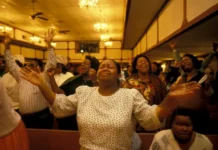

The Friday the calendar annually designates as Good represents a smorgasbord of arguably the best preaching in the African American faith community. Representing the sayings of Jesus while dying on the cross of Calvary, it also represents the genius, creativity and diversity of scriptural interpretation by those who are called and trained for pulpit ministry.
To one who loves good preaching, Good Friday offered the best of the best. With the help of contemporary technology, one could feast on sermons from 7 am through 10 pm, with hardly a break for the mandatory fish dinner.
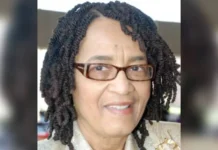
There were young preachers. Women preachers. Senior preachers. Men preachers. All accented by tremendous song and dance and instruments and organs.
From Suffering to Redemption
“The Seven Last Words is a storied and sacred preaching tradition in the Black Church,” said the Rev. Melanie Jones Quarles, associate professor of preaching at Union Presbyterian Seminary, in a recent interview with Religion News Service. “It allows preachers to interpret Jesus’ final utterances in ways that speak to the lived realities of their communities.”
The format is widely recognizable: seven clergy, often invited from different congregations or denominations, are each assigned one of Christ’s final sayings. Among them are “Father, forgive them,” “I thirst,” and “It is finished,” which together trace a theological arc from suffering to redemption.
The tradition’s emphasis on preaching also reflects the central role of the pulpit in Black church life, scholars say. According to Quarles, the format provides a unique opportunity for multiple voices to engage a single biblical narrative while showcasing the diversity of preaching styles.
In many cities, the service has become a collaborative event, drawing together churches and clergy across denominational lines. In Atlanta, Chicago and Baltimore, ministerial alliances annually organize joint Seven Last Words services that fill sanctuaries and, increasingly, draw livestream audiences.
Elevating Women in Ministry
The Meyerhoff Concert Hall in Baltimore was the first site of such a service, hosted by Bishop Donte Hickman, a prolific preacher and pastor of the Southern Baptist Church. Every seat was filled, and even the walls seemed to shout with the gospel and sing with the traditional hymns.
It’s not unusual to see the same pastor preach in more than one such gathering. Rev. Reginald W. Sharp, senior pastor of Fellowship Missionary Baptist Church in Chicago, hosted seven Morehouse graduates in a 9 a.m. service and then preached for one of them — Rev. Dr. Otis Moss III, senior pastor of Trinity United Church of Christ — at a later service.
The Seven Last Words is a storied and sacred preaching tradition in the Black Church. It allows preachers to interpret Jesus’ final utterances in ways that speak to the lived realities of their communities.
Rev. Melanie Jones Quarles, associate professor, Union Presbyterian Seminary
In Houston, Wheeler Avenue Baptist Church, where Dr. Marcus D. Cosby is senior pastor, hosted seven of its former interns. All are now senior pastors in their own right.
In more recent years, the Seven Last Words has also become a platform for elevating women in ministry.
Led by Dr. Judy Fentress Williams, a renowned Old Testament scholar, Alfred Street Baptist Church in Alexandria, Virginia, continued its tradition of seven women preachers telling the Good Friday story.
Faith and Social Justice
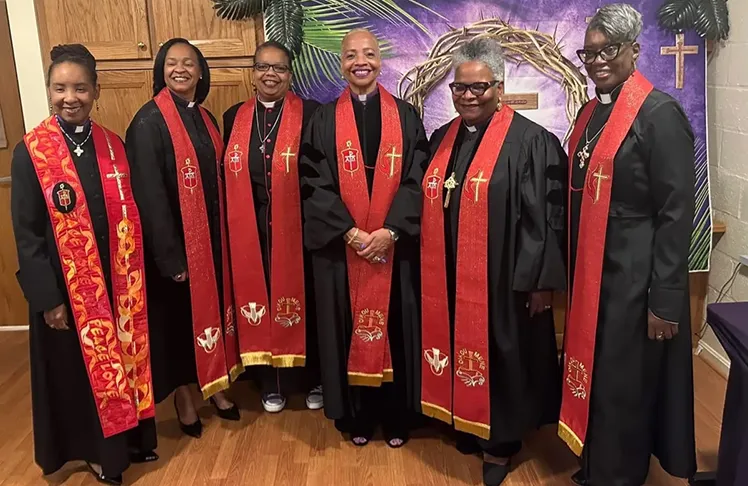
Rev. Jason O. Jordan-Griffin, senior pastor of St. Mark United Methodist Church in Hanover, Maryland, held a service featuring the preaching of seven bishops who are Black women. The Reverends Kennetha J. Bingham-Thai, Robin Dease, LaTrelle Easterling, Cynthia Moore-Koikoi, Sharma D. Lewis Logan, Tracy Smith Malone and Delores J. Williamston marked a historic moment for representation in a space long dominated by men.
Leaders say such developments reflect broader shifts within Black church communities, where women have long played central roles in ministry, yet have traditionally been excluded from prominent preaching opportunities.
At the same time, many congregations used the service to address contemporary social concerns. Some incorporated themes of racial justice, economic inequality and communal grief, drawing parallels between the suffering of Christ and modern-day experiences.
“The cross speaks to suffering in every age,” said Moss III of Trinity Baptist, in a Good Friday sermon archived by the church. “It reminds us that God is present even in the midst of pain and injustice.”
Remember, Reflect, Renew
Such interpretations are consistent with the historic role of the Black church as both a spiritual refuge and a center for social witness, particularly in times of national crisis.
Despite these evolving themes, the core of the Seven Last Words remains unchanged: a sustained meditation on the sacrifice of Jesus, held in tension with the hope of resurrection.
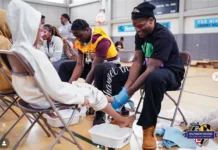
Worship services are often marked by solemnity, with congregants dressed in dark attire and choirs offering selections that range from traditional hymns to contemporary gospel. The altars are bare, having been stripped following the Maundy Thursday service that includes foot washing. The preaching builds in intensity as each speaker approaches the final word.
For many worshippers, the annual observance is both deeply personal and communally formative.
“It is a time when the whole community comes together to remember, reflect and renew its faith,” Quarles told Religion News Service. “The power of the Seven Last Words is that it invites us not only to hear Christ’s suffering, but to understand its meaning for our lives today.”