

By David W. Marshall
(Trice Edney Wire) – These are not normal times we are living in when it comes to the partisan gerrymandering war. The state of Virginia successfully passed a referendum that allows Democrats to hit back hard in their redistricting counteroffensive against the Republicans. Virginia’s current congressional delegation has six Democrats and five Republicans, which accurately reflects the state. The new map turns what was a fair depiction into an advantage, giving Democrats 10 of the state’s 11 districts.
This leaves the Republicans with 9% of the state’s congressional representation, despite Republicans and Republican-leaning voters comprising nearly half of the state’s electorate. The gerrymandering war demonstrates the latest action-reaction dynamic in electoral politics while becoming another example of Sir Isaac Newton’s third law of motion. Newton’s third law states that for every action (force) in nature, there is an equal and opposite reaction.
This means if object A exerts a force on object B, object B will exert an equal and opposite force on object A. President Donald Trump started this current redistricting madness by pressuring Texas legislators to adopt a map that favored Republicans in five seats currently held by Democrats. When Texas Gov. Greg Abbott and the Republican-led legislature complied, the Democrats didn’t accept it without a national fight. Voters in California and now Virginia have aggressively pushed back, “Donald Trump and Republicans launched this gerrymandering war,” House Democratic Minority Leader Hakeem Jeffries told reporters. “And we’ve made clear as Democrats that we’re going to finish it.” The political version of Newton’s third law is definitely in play with the president pushing Republicans to gerrymander their states on one side and the House minority leader doing the same with the Democrats on the other.
As I lead a social justice ministry at a local church in Maryland, we are challenged with the reality that many people are not paying attention to and understanding the political climate we face. Particularly, those with long-lasting consequences for the Black community. During a recent SJM meeting, I asked the members to tell me why they felt so many Black people do not consistently vote. The purpose of the question was to identify the reasons and then discuss ways to address them.
The variety of answers included: people don’t understand the voting process and its impact, people are in “survival mode” and focused more on the personal issues of their lives, people see politics as a game and are turned off by it, people don’t vote because there is too much division and voting adds to the division, people lost hope and believe their vote doesn’t count. Each response is understandable. The gerrymandering war can easily turn off voters because it is a game. It is a political game that reflects the constant power grabs for control in our social and political systems, and it feeds into the wide range of reasons people don’t vote.
If I were a voter in Virginia, I too would have voted for the referendum’s passage. In the past, I disagreed with any methods of mapmaking that disproportionally and unfairly flip congressional seats. Generally, gerrymandering is wrong when both parties act to predetermine election results. Before this latest war, Democratic states such as Maryland, New York, and Illinois were already heavily gerrymandered. But these are not normal times, and Newton’s law is needed to keep the aggressive Republican tactics in check.
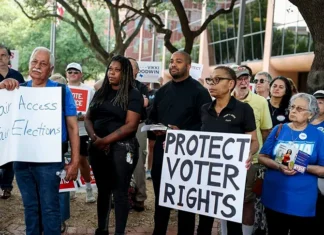
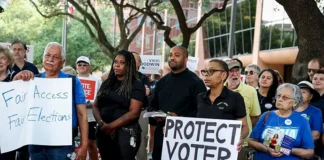
People must always have the assurance that their one vote does matter, even in this toxic political climate. The results of gerrymandered districts remain in the hands of the voters. The positive signs from Texas show that Hispanic support is not guaranteed to meet 2024 levels. As a result, the president’s plan to create five GOP-friendly districts may actually backfire. While people are correct in their assessment about the divisiveness of politics, it should never mean that political power and control are automatically turned over to elected officials by not casting their vote. Applying Newton’s law to aggressive Republican tactics doesn’t have to be left solely to Democratic-controlled state legislatures. It still comes down to voters in the general elections, especially in gerrymandered districts that remain competitive. It is an encouraging sign to see the opposition party step up. Just as the Democratic leadership pushed back on the issue of gerrymandering by way of a national strategy, can they do the same with the anti-DEI attacks?
David W. Marshall is the founder of the faith-based organization TRB: The Reconciled Body and the author of the book God Bless Our Divided America.