
Isn’t it wild that the same country that has both an illiteracy and an anti-intellectual problem has spent the last two weeks dissecting Kendrick Lamar’s Super Bowl Halftime performance?
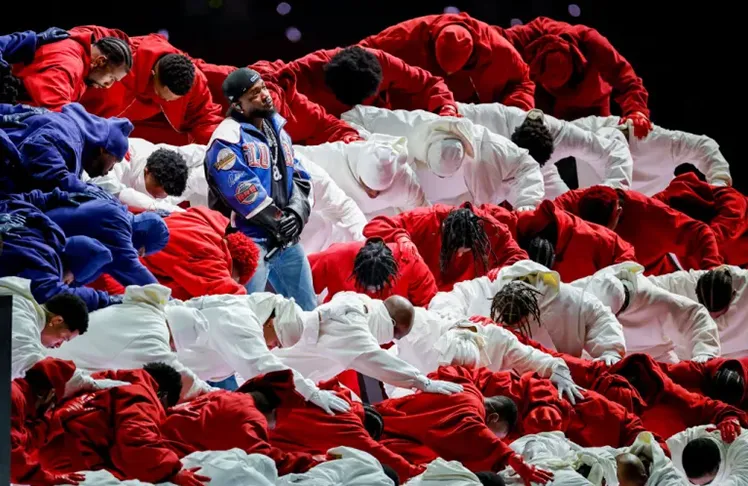
The performance — a 13-minute masterclass in artistry and cultural commentary — has naysayers’ opinions running the gamut from “I didn’t get it” to “It was too Black for me,” a sure sign that Lamar’s performance worked.
Nothing about Lamar suggests he would dilute his discography for people who refuse to get it. His resplendent use of America’s flag colors against his dark skin and his 400 co-performers’ skins — including SZA and Serena Williams — was a body blow to President Trump’s enterprise, co-president Musk, and the attempts of a plethora of unseen agents to erase the legislative, intellectual, and economic gains of civil rights movements.
you read the meanings folks are making from the performance, you see the ways people are integrating knowledge from expertise and experience and forming holistic narratives about this electric display.
The disparate reactions make me skeptical that we “all want the same things” for an education — and Lamar’s artistry was the clarion call to cultural and interpersonal arms many of us needed.
Multiple Kendricks in Our Classrooms
They’ll say “But, Jose, we’re not Kendrick Lamar.” You’re right. But if you listen to Regis Inge, an English teacher who taught Lamar, you recognize that we have multiple Kendricks in our classrooms. Mr. Inge explains how he views all of his students as capable of success.
In fact, in other videos, we see Mr. Inge’s pedagogy is firm, direct, and loving all at once. You also see him focused on the skills learned from reading whole books and looking at math problems holistically, not simple passages.
It’s a good lesson for schools. Some have derided holistic pedagogies as soft or inefficient. Yet, some of our most brilliant works have come from the amalgamation of these content areas. For instance, treating science and social studies as applied English Language Arts and math gives us keys from which to make our lessons more engaging and exploratory.
Of course, post-NAEP score release analyses have focused on drilling students with skills, but that’s not new. “Drilling” advocates have pushed for efficiency and regimentation of skills as opposed to a slower, more social, and student-led set of inquiries into their work. I’m not asking us to abandon skill-based lessons altogether. Yet, some people want to teach kids to read small passages, but not expand their capacity for character- and world-building. Why are we limiting students’ literacy when we’re seeing evidence that whole books are central to students’ desire for literacy?
A Spectrum of What’s Possible
I’m asking for a reformation of what we consider education. I want the spectrum of what’s possible in our classrooms and schools. Akin to how Kendrick Lamar approaches his music.
It’s worth naming how our current contexts haven’t helped.
American culture has moved from testing as one mechanism for assessment to testing as the education. While the Common Core State Standards anecdotally raised academic expectations, its implementation left much to be desired. As the public school population becomes more racially diverse, the teaching population has become less so, which decreases the likelihood of a Mr. Inge and so many others in our schools. Administrators who committed to culturally responsive education a few years ago have dropped even the faintest hints of “equity” from their lexicon.
As overt fascists seek to gain control of our federal government, a better-educated populace would have used their literacy and numeracy skills to connect the historical, global, and contemporary dots. But people around the world have seen this and can’t believe America has allowed it anyway.
Kendrick Lamar sent floodlights out to the rest of the world that some of us been knowin.’
Building Curiosity and Collective Learning
What would it take for us to move towards tapping more into curiosity and exploration? It starts with adults believing every student deserves experiences with curiosity. Schools with more students of color or students in poverty seem to never have permission to do “progressive” pedagogies. From there, we would do well to see how our lessons provide those student-led opportunities. It also means that we need to expand notions of “assessment.” The best teachers I know have a strong sense of students’ skills, but also their potential and how to elevate it.
But also, we should introduce more social learning, i.e. the extent to which students learn together rather than individually.
The community learning element means students get to reach out to one another to solve problems and gain perspectives they otherwise wouldn’t. Imagine if that was a principle we embraced towards a more authentic democracy. Breaking out of silos means we should interrogate who put them there in the first place. Unifying a nation by stripping othered people of their rights, liberties, and communities’ expressions is no unity at all. We have multiple opportunities to exemplify this for our students in our institutions of learning i.e. our schools.
Kendrick Lamar sent America a message about what we know. A teacher gave him the skills to disseminate this to one of the world’s largest audiences. Up to now, many more classrooms are banning students from this pedagogy.
Will America listen?
José Luis Vilson is a veteran educator, writer, speaker, and activist in New York City. He is the author of “This Is Not A Test: A New Narrative on Race, Class, and Education.” He has spoken about education, math, and race for a number of organizations and publications, including the New York Times, The Guardian, TED, El Diario / La Prensa, and The Atlantic.
He’s a National Board Certified Teacher, a Math for America Master Teacher, and the executive director of EduColor, an organization dedicated to race and social justice issues in education. He holds a doctorate from Teachers College, Columbia University. He serves on the board of directors for the National Board of Professional Teaching Standards and PowerMyLearning. A version of this post originally appeared at The José Vilson.