
By John Fritze, CNN
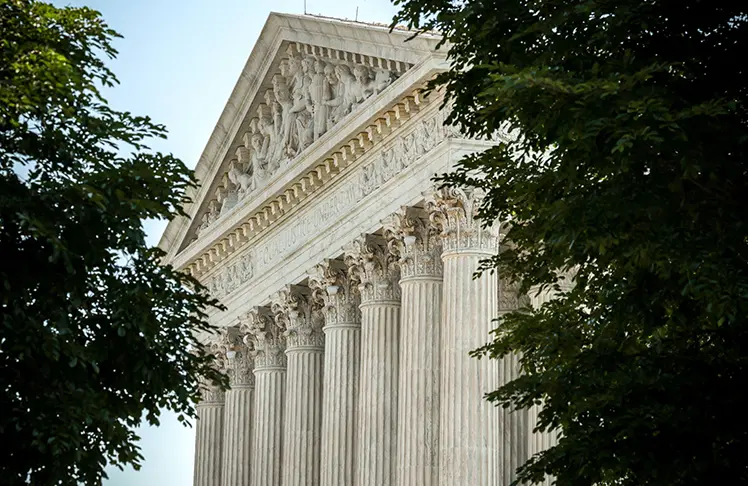
(CNN) — The Supreme Court on Tuesday allowed Alabama to use a congressional map that will benefit Republicans in this year’s midterm elections, permitting the state to ditch one of two House districts represented by a Black member of Congress who is also a Democrat.
The court dealt with the case in an unsigned order over the dissent of the three liberal justices and despite the fact Alabama has already held congressional primaries. As a result, Alabama will likely have six GOP members of Congress next year, with only one Democrat.
The order on the court’s emergency docket is the latest instance of the justices dipping into the nationwide flurry of mid-decade redistricting instigated by President Donald Trump’s desire for the GOP to retain control of the House in this November’s midterms.
Over the course of several months, the Supreme Court has had a hand in congressional maps in Louisiana, Texas, Alabama, Virginia and California. Most of those decisions have benefited the Republican Party.
Tuesday night’s order relied in part on a legal doctrine known as the Purcell principle that bars federal courts for interjecting in election disputes to change the rules of voting on the eve of an election.
In this case, the court said in its order, “the District Court interposed itself into Alabama’s ongoing efforts to conduct its imminent 2026 congressional elections under maps that its elected representatives selected.”
“Its view that conducting the elections under court-imposed maps would be more convenient for the state was not a valid justification for that intervention,” the majority wrote. “While federal courts should not impose changes close to an election, states are free to decide for themselves whether last-minute changes to an election are in their best interests.”
The decision drew a sharp dissent from Justice Sonia Sotomayor, joined by the court’s other two liberals.
“Now the court is squarely faced with a record of the turmoil it has caused and the harm it has wrought,” Sotomayor wrote. “Yet just as Alabama doubled down on racial discrimination, the court today doubles down on chaos.”
Sotomayor added: “Because I choose to defend the rule of law and the right of all Alabamians to participate equally in democracy, I respectfully dissent.”
Gutting of Voting Rights Act has immediate consequences
The Alabama case is the latest emergency order tied to the court’s April 29 decision on the Voting Rights Act, in which a 6-3 majority gutted the ability of groups to bring claims of racial discrimination under that 1965 landmark law. The decision essentially requires voting rights groups to find a “strong inference” of intentional racial discrimination before proceeding with a lawsuit.
Several Southern states moved quickly after that decision to redraw their maps. Tennessee and Florida, for instance, have both enacted new congressional districts that advantage the Republican Party.
Even though Alabama already held its primary election in May, Republican Gov. Kay Ivey signed legislation authorizing special elections in August for the affected congressional districts if courts allow the state to use its new map.
Democratic Reps. Shomari Figures in the 2nd District and Terri Sewell in the 7th District are the two Black members of the state’s seven-seat congressional delegation. Republicans could reclaim Figures’ district with the new map, but it’s not clear exactly how the electoral process will play out before the midterms.
Steve Vladeck, CNN Supreme Court analyst and professor at Georgetown University Law Center, said the court’s ruling shows an inconsistent application of its own precedent.
“The animating premise of the Purcell principle is that federal courts are supposed to stay their hand as election day draws near,” Vladeck said. “And yet, this ruling is the third different time the justices have intervened in ongoing election processes in the five weeks since the merits decision in the Louisiana case.”
“The majority opinion claims this intervention is necessary because of Purcell, but what the court has really done in the last month is to apply that principle to everyone except itself,” Vladeck added.
Sewell slammed the ruling in a statement Tuesday night, writing, “This is just the latest in a pattern of outrageous Supreme Court decisions that help Republicans desperately cling to power ahead of the midterm elections while diluting Black voices and erasing decades of hard-fought civil rights progress.”
Alabama’s recent history with the Supreme Court
Alabama’s legal battle over its maps has repeatedly made it up to the Supreme Court in the past.
The Supreme Court in 2023 effectively required Alabama to redraw its congressional map to allow for an additional Black district, upholding a lower court decision that found the state likely violated the Voting Rights Act by enacting a discriminatory map. Ultimately, voters in Alabama cast their 2024 ballots under a court-drawn congressional map that led to the election of two Black and Democratic representatives out of seven seats.
While Alabama continued to challenge that map on appeal, the Supreme Court decided the Voting Rights Act case in late April. Based on that decision, Alabama rushed up to the Supreme Court in early May asking the justices to toss out the court-ordered map that it used in 2024 in time for this year’s midterm elections. The court’s conservative majority agreed to that request on May 11 over the dissent of three liberal justices.
The high court’s decision, Sotomayor wrote at the time, “unceremoniously discards” the lower court’s decision finding that the state engaged in intentional discrimination “without regard for the confusion that will surely ensue.”
But a special three-judge court in Alabama unanimously shot down the state’s map again last week. The court ruled that Alabama likely violated the Voting Rights Act, even with the Supreme Court’s new high standard, as well as the equal protection clause of the 14th Amendment.
That three-judge panel was made up of two judges appointed by Trump and a third was named by President Bill Clinton.
“Ultimately, we cannot see our way clear to requiring Alabamians to cast their votes in the 2026 elections under a districting plan tainted by intentional race-based discrimination,” the panel wrote.
This story has been updated with additional details.
The-CNN-Wire
™ & © 2026 Cable News Network, Inc., a Warner Bros. Discovery Company. All rights reserved.