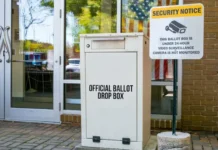

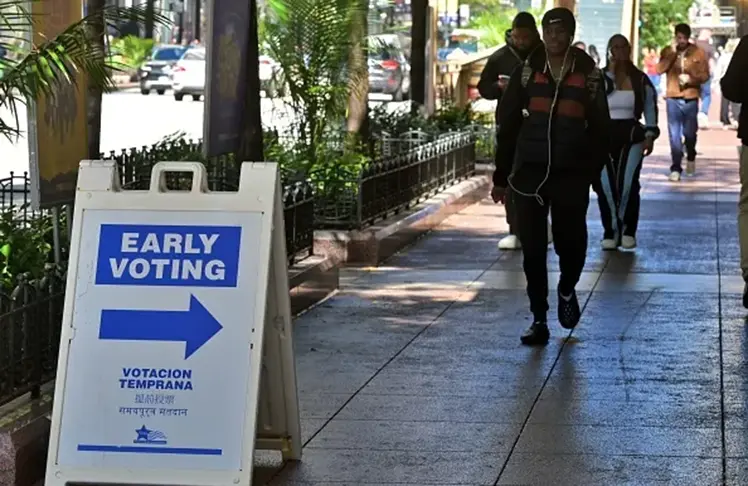
With the midterm elections less than four weeks away, and early voting already starting in some states, Black voters are heading to the polls with a familiar knot in their stomachs, worried that democracy itself — and their civil rights — is on the ballot.
The anxiety is palpable: several polls mirror a new Leadership Conference on Civil and Human Rights survey that found 82% of likely voters fear their rights are being rolled back. Nearly as many believe democracy is under serious threat, and a national survey of Black women found that 9 in 10 are dissatisfied with the direction of the country.
Roughly 37% of Black Americans doubt or don’t believe their state and local governments will run fair elections, compared with around 27% of white Americans. Experts trace the anxiety to President Donald Trump’s defeat of Vice President Kamala Harris in the 2024 general election — a result that also ushered in a far-right agenda that included rolling back civil rights protections.
“People are at their edge, and understandably so,” says Dr. Wendi Williams, president of the American Psychological Association.
Voters, she says, want answers: “When will the vote that I cast be counted? Will someone figure out a way to take away the vote that I cast, and so on and everything in between? Can we trust the people who are running to follow up and do the things they say that they can do or that they will do?”
Distrusting the Process
Anxiety about the election process itself, signaling distrust, is also running high.
A Gallup/Kettering Foundation survey of 23,683 adults, conducted April 24–June 10, found that 67% were concerned about political leaders pressuring election officials to change outcomes, and 73% were concerned about multiple aspects of the election process. Half worry their own ballot will not be counted. Heavy social media users, who spend three or more hours a day on the platforms, reported more concern than non-users.
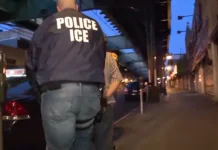
The survey also found more than 3 of 4 Black adults, more than any other group, were concerned about peaceful protesters being harmed by federal agents, the military, or police, compared with 60% of white adults.
Williams is also the author of “Black Women at Work: On Refusal and Recovery” and co-editor of “The Majestic Place: The Freedom Possible in Black Women’s Leadership.” She sees the anxiety in the Black community as a broader rupture in the fabric of the culture, focused in part on Black women.
“I think that we are living through a simultaneous reckoning of the devaluation of Black women and Black women’s leadership, and also the consequences of not having it in key places and spaces right now,” she said. She described politics, the economy and public systems marked by what she called “a lack of care.”
That reckoning played out publicly in late August, when far-right activist Laura Loomer posted racist and sexist attacks aimed at Florida state Rep. Angie Nixon, now the Democratic nominee for U.S. Senate, and other prominent Black women. Williams said such rhetoric has consequences well beyond its targets.
“When you normalize a dehumanization response or treatment of people, then it gives it a permission structure,” Williams says. The cumulative effect, she said, is “giving permission that we still don’t have to care about anybody, and that becomes pretty nihilistic.”
Taking Back Your Power
Clinical psychologist Dr. Calvin Fitch has a name for what that cultural environment does over time: “disempowerment stress.” He says it comes from living in a society that stigmatizes minority identities through chronic systemic oppression.
Over time, he says, disempowerment stress “starts to erode core psychological faculties,” he says, wearing down agency and a sense of safety.
Fitch — who founded “Courageously You,” a set of self-help resources for Black gay, bisexual and trans men — works with marginalized groups, including Black and LGBTQ+ clients, and he built the concept based on minority stress research.
“It starts to feel like life is just happening to you,” Fitch said, “and you sort of start to become accustomed to things happening to you.”
To help patients cope, Fitch separates the “flame” from the “gas.” The flame is the immediate trigger: a headline, a social media post, a political event. The gas is the stress already in the air, such as past experiences of racism, anti-LGBTQ+ stigma or invalidation, that “makes this hit even harder,” Fitch said.
Naming the gas, he said, helps explain why a given moment lands so hard.
“We cannot solve every systemic issue in one interaction, but we can choose meaningful actions: finding validating community, platforming people and organizations that are speaking out, giving less of a platform to people who are remaining silent or [seem to be] supporting” the attack.
Whatever their politics, Williams hopes Black voters recognize the stress and “vote for the care of each other.”
She also urged people not to dismiss small acts of restoration: rest, spirituality, time in nature, a 10-minute walk, a call to someone who “just loves the pants off of you.”
“It is not a waste,” she said.
Help Is Available: If you are experiencing a mental health crisis, are thinking about suicide, or worried about someone else who needs emotional support, call or text the Suicide & Crisis Lifeline at 988. Help is available 24/7. TTY users can dial 711 then 988 to get help.