

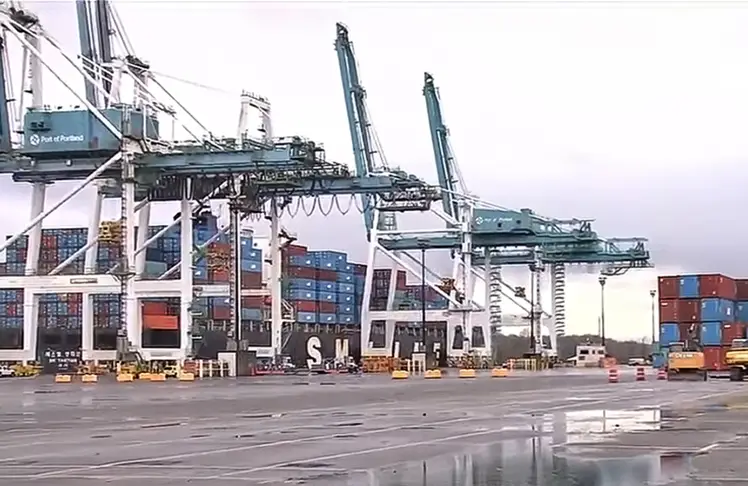
Oregon’s only international container gateway, the Oregon Container Terminal (OCT), has officially resumed operations after a tumultuous period that threatened its closure. The terminal, located at Portland’s Terminal 6, began its new chapter on January 7, following a successful transition from the Port of Portland to Harbor Industrial Services under a long-term lease agreement.
The reopening marks the culmination of a multi-year collaboration among state leaders, port officials, labor organizations, and private operators determined to maintain container service for shippers in Oregon, southwest Washington, and Idaho. “Global connections like these give Oregon a competitive edge and help secure our economic future,” stated Governor Tina Kotek during the opening ceremony, emphasizing the terminal’s essential role in transporting various goods, including coastal cranberries, Willamette Valley hay, and Eastern Oregon wheat.
The terminal boasts direct vessel service, dual-rail access through BNSF and Union Pacific, and plans for future barge connections to inland markets. Weekly container service has already commenced, benefiting agricultural, manufacturing, technology, and retail exporters throughout the region.
Tim McCarthy, president of OCT, highlighted the terminal’s capabilities, stating it offers shippers “a stable, efficient, and competitive gateway,” supported by 210 acres of developed infrastructure and an experienced workforce. The reopening is particularly significant given Terminal 6’s turbulent history; in 2024, the Port of Portland announced plans to cease container operations due to financial losses and labor disputes. This decision was reversed after Oregon lawmakers secured $20 million in state funding for essential upgrades, urged by Governor Kotek.
By September 2025, Harbor Industrial was selected as the long-term operator, transitioning from a stevedore to a full terminal operator—a model commonly used in container ports globally. Port Executive Director Curtis Robinhold remarked that this agreement ensures efficient cargo movement for exporters and importers while supporting thousands of family-wage jobs statewide.
The terminal is a vital asset for Oregon, supporting approximately 1,500 jobs and contributing significantly to the state’s trade-dependent economy. Oregon exports around $42 billion in goods and services annually, with nearly one in eight jobs linked to international trade, predominantly involving small and medium-sized businesses.
State Rep. Shelly Boshart Davis, R-Albany, who played a critical role in securing funding for the terminal’s upgrades, expressed optimism about the reopening, stating it “flips the script” for Oregon shippers after years of instability. Additionally, Stuart Strader from ILWU Local 8 praised the project as a prime example of successful collaboration among labor, government, and industry.
The launch also introduced Harbor Industrial’s “Ship Oregon” initiative, designed to encourage businesses to use Oregon ports for cargo transport, aiming to reduce costs, alleviate highway congestion, and strengthen in-state supply chains. After nearly a decade of uncertainty, the resumption of container service at Terminal 6 provides Oregon exporters with a reliable gateway to global markets once again.