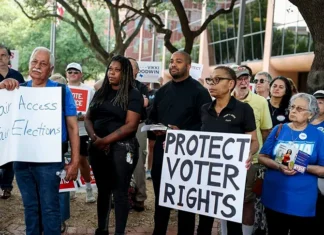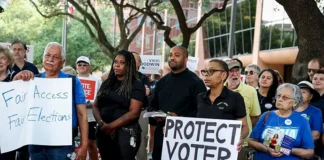


A federal judge has ruled against most provisions of President Donald Trump’s executive order on elections, particularly impacting the vote-by-mail states of Washington and Oregon. U.S. District Judge John H. Chun issued the decision on Friday, asserting that the requirements for documentary proof of citizenship and mandates for ballot receipt by Election Day exceeded the president’s authority.
The ruling aligns with previous decisions made in similar cases, including one in Massachusetts involving 19 states and another in Washington, D.C., brought by civil rights groups and Democratic organizations. “Today’s ruling is a huge victory for voters in Washington and Oregon, and for the rule of law,” remarked Washington Attorney General Nick Brown. He emphasized that the court upheld the principle that only states and Congress have the authority to regulate elections, not “the Election Denier-in-Chief.”
The executive order, issued in March, sought to impose new requirements, including mandatory documentary proof of citizenship for voter registration and a stipulation that all mail-in ballots be received by Election Day. This directive raised concerns among officials in Oregon and Washington, which allow ballots to be counted as long as they are postmarked by Election Day. They warned that enforcing these requirements could disenfranchise thousands of voters. In the 2024 general election alone, Washington counted nearly 120,000 ballots received after Election Day but postmarked by it, while Oregon saw nearly 14,000 such ballots.
Judge Chun highlighted the violation of the separation of powers inherent in Trump’s executive order, noting that the Constitution assigns the regulation of federal elections to Congress and the states. “This is a win for Oregon voters and a defeat for President Trump’s effort to interfere in our elections,” stated Oregon Attorney General Dan Rayfield. He added that the ruling allows Oregonians to register and vote without the fear of arbitrary restrictions imposed by the president.
Oregon and Washington opted to file separate lawsuits from other states due to their unique status as exclusive vote-by-mail states, which they argued faced particular risks from the executive order. Meanwhile, Trump and his supporters have often claimed that noncitizen voting is a widespread issue; however, evidence shows that instances of noncitizen voting are exceedingly rare, and those caught face serious legal repercussions, including felony charges and deportation.
This ruling not only reinforces the integrity of the voting process in these states but also underscores the importance of maintaining established election laws that protect citizens’ rights to vote. As the legal battles surrounding voting rights continue, this decision represents a significant step in the ongoing struggle over election regulations in the United States.