

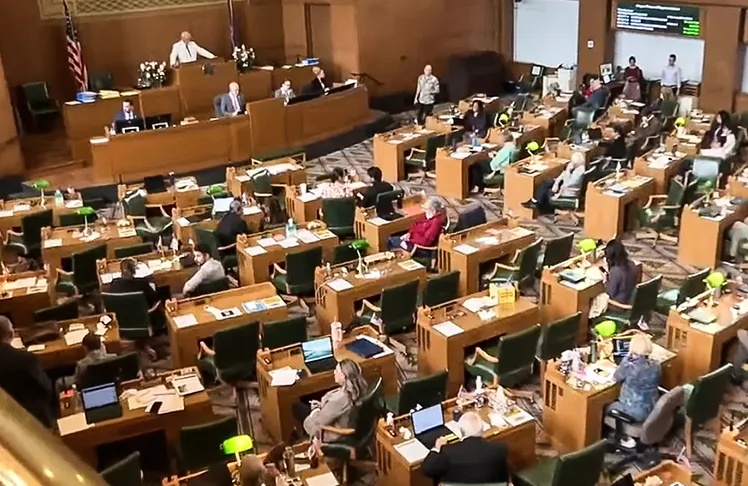
On Friday, House Democrats voted to protect the Oregon National Guard from being utilized for law enforcement purposes or deployed by the federal government without the governor’s consent. This action comes amid ongoing legal discussions surrounding President Donald Trump’s authority to deploy the California National Guard. Rep. Paul Evans, D-Monmouth, stated that although he did not initially intend to introduce House Bill 3954, he believed it was essential to uphold longstanding traditions and legal precedents.
A three-judge panel from the Ninth Circuit Court of Appeals ruled on Thursday that Trump likely possesses the authority to deploy the National Guard, overturning a previous decision made by a federal district judge in California. Legal debates over this issue are still ongoing. The bill passed with a vote of 32-16, with all Democrats in favor and all Republicans opposed, and no opponents addressed the assembly regarding the legislation.
Evans, a 20-year veteran of the U.S. Air Force and Oregon Air National Guard who has served in combat missions in both Iraq and Afghanistan, expressed concern about his colleagues’ understanding of military conflict, noting that many may not have experienced the realities of civil war or combat firsthand.
The proposed legislation would prevent Oregon’s adjutant general from collaborating with the U.S. Defense Department or any military branches, except for missions or training authorized by Congress. Additionally, it would explicitly prohibit the Oregon National Guard from engaging in law enforcement or immigration enforcement. Furthermore, the bill would restrict the adjutant general from activating any National Guard members if such actions would hinder the Guard’s ability to respond to statewide emergencies, including wildfires, earthquakes, and terrorist attacks.
Rep. Dacia Grayber, D-Beaverton and a cosponsor of the bill, highlighted the urgent need for this legislation by presenting a wildfire risk map on the House floor. The map indicated alarming fire risks throughout Washington and Oregon, as well as large portions of northern California and most of Montana and Idaho. With over 20,000 acres burned and 56 homes destroyed near The Dalles and in central Oregon, Grayber, who also works as a firefighter, noted that in her 30 years of experience, it was unprecedented to see the Northwest in such a dire situation as indicated by the National Interagency Fire Center’s map.