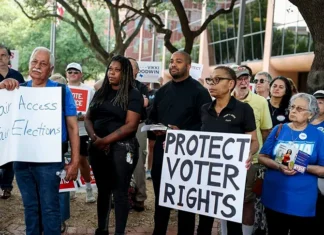


In Oregon, the current electoral system allows Democrats to vote only in Democratic primaries and Republicans in Republican primaries, leaving approximately 44% of voters—those who are unaffiliated or belong to minor parties like the Independent Party or Libertarian—excluded from the process. For years, advocates have sought to reform the state’s election system to allow open primaries for all voters. An attempt in 2024 to bring this issue to the ballot did not succeed, but now, efforts are underway again with a notable supporter.
Recently, two new initiatives have been filed that would enable voters to decide on amending both state law and the state constitution to open primaries to all voters. One of the key figures backing this effort is former Democratic Governor Ted Kulongoski, who is joined by former state Representative Cheri Helt, R-Bend, and Andrew Kaza, co-chair of the state Independent Party of Oregon.
Kulongoski, who has held positions across all three branches of government—including state legislator, attorney general, and Oregon Supreme Court justice—expressed concern that both major parties are increasingly catering to special interest groups and affluent donors, rather than addressing the needs of a broader electorate. He highlighted the growing number of voters who do not affiliate with a specific party.
“When this is on the ballot, half of the people in the state will be registered as neither Democrats nor Republicans. I believe parties should have to appeal to these independents to justify why their candidate is the best choice,” Kulongoski stated.
Initiative 55 seeks to amend the state constitution to eliminate partisan primaries. Meanwhile, Initiative 56 proposes a ranked-choice primary system where all candidates appear on a single ballot, with the top two advancing to the general election. Both initiatives are collectively referred to as the “Voters Fairness Act.” To qualify for the November 2026 ballot, supporters must gather 156,000 signatures for the constitutional amendment for a top-two primary system and 117,000 signatures for the law change to open party primaries.