
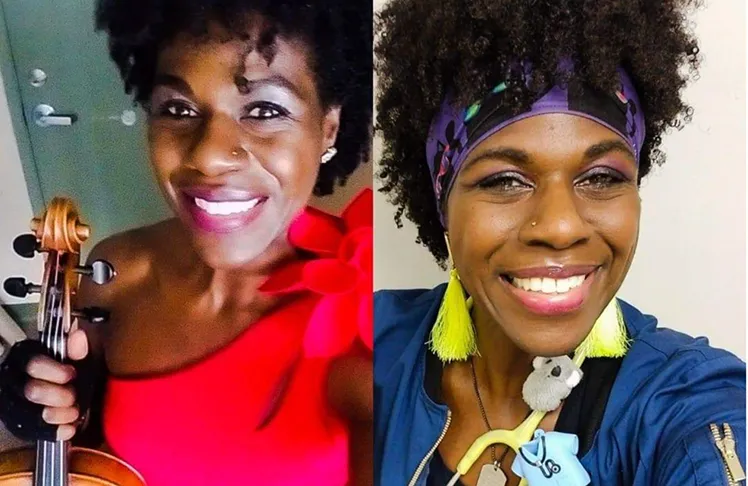
A compliment to Robin Fay Massie is certain to elicit her response of, “It’s God, or it’s the Lord.” She’s careful, as good Christians say, to give God all the praise and glory for her life. It’s more than an affectation; it’s her entire life.
And what a life it is. She’s a full-time school nurse in Atlanta by day, a neonatal intensive care unit nurse by night and a freelance classical violaist.
As such, Massie’s life sits at the intersection of faith, caregiving, and artistry, where her work as a school nurse and professional violist becomes a single ministry rooted in service. From Baltimore to Atlanta, her journey shows how devotion to God shapes not only her calling but the way she heals, performs, and moves through the world.
Few Black Classical Musicians
A freelance musician, “I perform with organizations like the Atlanta Opera and Atlanta Symphony,” she says. “I’ve also worked with groups like the Philadelphia Orchestra and National Symphony. I also do chamber music and work through the musicians’ union, which has been incredibly helpful for opportunities and support.”
I believe pain connects us, but joy heals us—and true joy comes through Jesus Christ. I want anyone who encounters me to feel like they’ve been touched by him.
Robin Faye Massey
The field, however, can be challenging for Black classical musicians.
A 2023 study found that Black people represented 2.4% of musicians in surveyed American orchestras, but for string players like Massie, representation for Black string players — violin, viola, cello, and bass — is often even lower.
There has been growth, albeit slowly: the percentage of Black classical musicians increased from 1.8% in 2014 to 2.4% in 2023.
‘From the Very Beginning’
Massie’s musical journey began in Baltimore when her parents managed to get her a second-hand piano she had long coveted.
”It was just sitting in someone’s house, not being played,” she says. “It wasn’t financially easy for them, but they got it for me. And I loved playing it from the very beginning.”
Later, Massie’s musical interests migrated to the violin — her second musical love. But it was not to be: “My teacher, my mentor, said the notes I played leaned more toward the lower instrument,” the much larger viola,” she says.
That was her next musical challenge, and that’s where she remains.
Though Massie isn’t officially connected to any orchestra, some critics have become enamored of her playing. They include Michael Caruso, a Philadelphia-area journalist who reviewed one of Massie’s performances.
“Especially noteworthy was the strength of Massie’s playing,” he wrote. [Her] strongly projected and beautifully modulated brawny tone made certain that her voice would be heard.”
Personal Caregiving Journey
Massie’s relationship with the Lord was nurtured from the beginning by her parents and has grown to be the central part of her life. Each day begins with a consultation with the Lord and orders for the day.
”Then I say, ‘O.K., let’s go to the gym,” Massie says.
Massie is divorced, but she began her transition to nursing by providing care for her then-husband.
”I knew I had to take care of him regardless of his resistance at the time. I was at peace with it even if he wasn’t,” she says. Her next assignment was caring for her mother, who was having trouble managing diabetes.
The healing touch, Massie says, merges with her faith.
“I just want everyone I care for to know they’ve been touched by the Lord.”
Word in Black: Tell me about your work as a nurse.
Robin Fay Massie: I believe that music and nursing, for me, are one spectrum of care, really doing God’s work. It’s ‘heart’ ministry. I knew from a young age that I wanted to help people, even before I fully understood what that meant.
It wasn’t until 2016, during a very difficult time in my life, that I stepped into nursing. My then-husband was struggling with health issues and addiction, and he became my first patient in a sense. I remember saying, ‘God, I don’t know what I’m doing, but I’m going to take the next best step.’ And I did.
WIB: How did music become a profession for you?
Massie: I started piano at four years old. My parents saw that I wasn’t just playing—I was connecting with it—so they sacrificed to get me lessons. At eight, I fell in love with the violin, and at fourteen, a mentor introduced me to the viola. The moment I played it, I knew that was it.
WIB: Now, I know you were taking care of your mom. How’s that going?
Massie: That has been a profound part of my journey. I moved to Atlanta to care for my mom when I saw her health declining. She’s diabetic, and things weren’t well-controlled. I left Baltimore without a job, without a plan—just trusting God. I call that my ‘wilderness season.’ But he provided every step of the way.
Today, my mom is doing so much better. She had surgery and is now standing upright for the first time in years. My brother is also doing well, and I’m able to help care for him, too. It’s clear to me now that God prepared me through nursing for this very purpose.
WIB: How does your faith sustain you as well as propel you in life?
Massie: I want to leave this world better than I found it. I believe pain connects us, but joy heals us—and true joy comes through Jesus Christ. I want anyone who encounters me to feel like they’ve been touched by him.
I start my day intentionally with the Lord because that prepares me to meet others. For me, everything—music, nursing, life—is about the heart. I have to examine myself before I can pour into anyone else. And I strive to show up with joy, because that’s what draws people to him.