
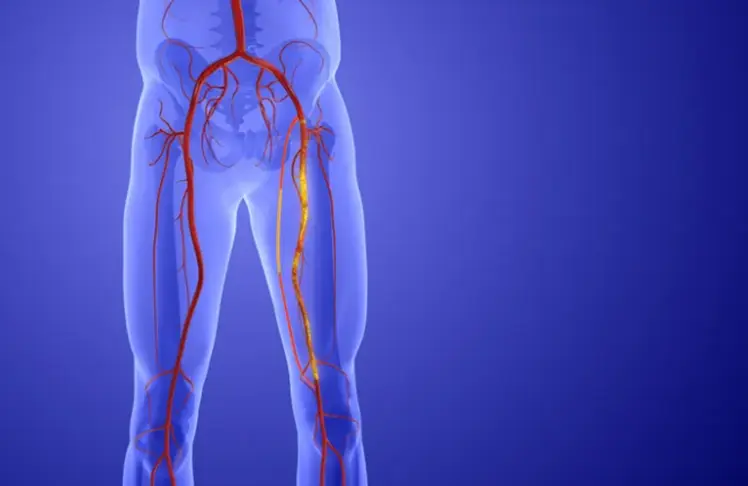
Estimates are that more than 7 million to 12 million people in the U.S. live with blockages in the body’s blood vessels, a condition causing chronic pain and, left unaddressed, can lead to amputation. Often assumed to be just another symptom of aging, the illness — peripheral artery disease, or PAD — can be worsened by obesity, smoking, and high blood pressure.
Yet despite being relatively common and disproportionately affecting Black Americans, few people have actually heard of PAD. A 2024 survey found almost 70% of respondents weren’t familiar with it, and nearly 8 in 10 Black and Hispanic adults hadn’t heard about PAD from a doctor or healthcare provider.
Dr. Xzabia Caliste, a board-certified vascular surgeon, is working to change public understanding of PAD, a condition more commonly associated with heart disease. PAD causes blockage in the vessels that carry blood from the heart to the legs.
“Think of it as one single plaque-building process happening throughout the blood vessels,” says Caliste, a physician at Albany, New York, Medical Center and an assistant professor at Albany Medical College. “The diseased blood flow in the coronary arteries going to your heart is part of the same picture as what’s happening in your legs.”
The Society for Vascular Surgery says the top three risk factors for PAD are diabetes, high blood pressure, and use of tobacco products. Black people diagnosed with the disease experience more complications, which can range from cardiovascular diseases affecting the heart and brain to limb amputations and even higher rates of depression.
Word In Black spoke with Caliste about what to know about a disease that is more common than most people realize and the various kinds of treatment available. The interview has been edited for length and clarity and should not be considered as individual medical advice.
WIB: What is peripheral arterial disease and how does it develop?
Dr. Caliste: PAD starts like a clogging of your arteries — the same process that happens in the arteries to the heart also happens in the legs. Plaque builds up and narrows blood flow and oxygenation to your muscles. It’s one plaque-building process throughout the blood vessels — diseased blood flow in the heart’s arteries is part of the same picture as the legs.
Patients, typically 65 and older, report cramping or tiredness when walking, and often think it’s just natural aging. But oftentimes it’s not.
Treatment can be as simple as using exercise and medication to decrease cardiovascular risk and reduce the effects of the accompanying diseases that lead to PAD, such as high blood pressure, diabetes, smoking, obesity. Advanced treatment methods can include inserting stents or balloons into the arteries, or even surgery.
WIB: How do people ultimately get diagnosed, when they may have had leg pain that they think is just another sign of aging?
Caliste: The first step is being aware of your body, and thinking, “Maybe this isn’t just normal aging.” That’s when you go to your primary care doctor and say, “My legs hurt when I’m walking. Can we do an ABI [ankle-brachial index] test?”
It’s simple: a blood pressure cuff on the arm and ankle, and you take the ratio between the two. Normal is 0.9 to 1.3. Below 0.9, we’ve got a problem — there’s clogging somewhere. Any provider—whether in an emergency room or a doctor’s office—can conduct this test. From there, you can be referred to a vascular surgeon for formal testing.
That applies even without a diabetes diagnosis. Any wound needs to be assessed — a large proportion of diabetic patients actually have PAD too, since diabetes is itself one of the problems that leads to it. If you have a wound, you need a vascular check, no matter what.
What is the relationship between smoking and PAD specifically?
Caliste: Smoking is huge. Below the knee, in the smaller vessels, you get spasms — on top of plaque buildup, so even less oxygen is reaching the calf muscles. Smoking just exacerbates the whole problem, and it affects other vasculature too. Smoking makes everything worse.
Quitting is optimal to decrease risk and halt progression. Having patients quit is optimal to decrease these risk factors and at least halt the progression of what might already be occurring.
WIB: Does the danger come from the nicotine itself, or does the delivery mechanism — a cigarette vs. a nicotine patch — matter?
Caliste: It’s the nicotine, particularly. Obviously, cigarettes themselves have other toxins associated with them. I know the patch is used to help get people off actual cigarettes, so I’m not going to characterize the patch itself as a negative — it’s a mechanism that helps decrease harm, and I think that’s helpful.
There are several options, and whatever works for you, I want you to do that, because it will actually get people successfully out of the habit of smoking, however many packs a day. That’s really key: decreasing your nicotine intake. If you have to use the patch as a bridge to getting off actual cigarettes, and it works, that’s a mechanism that works.
WIB: With people losing healthcare coverage, many are turning to “Dr. Google” and AI chatbots for diagnoses and medical advice. What are the limits there?
Caliste: They’re just tools to assist us, not the end-all and be-all. They are not your physician. They might give you ideas of what things could be, but that’s not something to rely on solely.
Everyone needs to see a physician for proper testing. If you don’t have a primary care physician, then an urgent care center is the right option.
WIB: What does treatment typically look like after a vascular check?
Caliste: We assess you with appropriate testing. The first step is usually lifestyle modification and optimizing medical problems — diabetes, blood pressure, and cholesterol all need to be controlled, plus medication and exercise.
And for exercise, I put patients on a walking regimen — 30 minutes, three days a week, ideally five to seven. It’s easy and accessible — you don’t need a gym. You can walk around your block. The further you walk with a regimen, the further you’re able to walk through the pain. No need to train for marathons or Iron Man contests.
WIB: People hear the title “surgeon” and assume you’ll move straight to cutting.
Caliste: That’s not the case. There’s so much we can do before an amputation. There are about 400 amputations a day in this country, but many can be avoided with earlier care. This disproportionately affects African Americans and Hispanic Americans, given the higher preponderance of high blood pressure, diabetes, obesity, and smoking.
A lot of people with PAD don’t need an operation; some do need one because they come to me further along–and those are the patients who have limbs and lives we’re trying to save. But an amputation can be a toe instead of a foot — minimizing the problem rather than letting it become something major. My job is to save your limb and your life. The sooner you come in, the better your chances of walking with your grandkids, going to the mailbox without pain.
WIB: What kinds of cases stand out to you?
Dr. Caliste: I’ve seen people show up with limbs that are rotting — how did we get here? That doesn’t happen overnight. Sometimes people bury their heads in the sand out of fear, and sometimes they simply lack access — insurance, or time off work during set office hours. Those social determinants of health are real. On the good side, I’ve done leg bypasses that saved a foot, placed stents that restored blood flow, healed wounds before a toe became gangrenous. Those saves are why I do this job.
WIB: What is the most urgent fact you want potential patients—which is all of us—to know?
Caliste: A lot of concerns are worsened when attached to fear — people have seen family or friends lose limbs, and our community ignores things because we don’t want that to happen to us.. PAD is common — it’s an epidemic. Millions in this country have undiagnosed PAD, and it’s a harbinger for cardiovascular disease — compromised blood flow in your legs likely means it’s in your heart too.
I want people to feel empowered to advocate for themselves and to know you are empowered to ask for vascular checks. And I’d point everyone to the website yourvascularhealth.org to get factual information from actual medical professionals, instead of ChatGPT.
Empower yourself, get a little knowledge, and be an advocate.