

By Jacopo Prisco, CNN
(CNN) — The skies of Oklahoma City roared for six months in 1964 as military aircraft intentionally rattled the population below with a daily barrage of thunderous sonic booms. It was a controversial test — the consequences of which have lingered to this day.
The booms — 1,253 in total — were part of an effort by the US Federal Aviation Administration to gauge the public’s attitude toward supersonic flight. Faster than the speed of sound, such flights hold the potential to cut travel time in half. But the test was a major catalyst would eventually spell doom for commercial supersonic journeys over the United States.
Congress canceled funding in 1971 for Boeing’s proposed supersonic aircraft, the 2707, leaving only two contestants in the passenger supersonic race: Europe’s Concorde and the Soviet Union’s ill-fated rival model, the Tupolev Tu-144. Then, the FAA effectively banned civilian supersonic flight over land in the US in 1973 by prohibiting civil aircraft from flying faster than Mach 1, or the sound barrier, thus preventing sonic booms. Concorde became the only commercial supersonic airliner, flying the skies from 1976 to 2003. The jet never had a successor.
Now, some 50 years on from the ban, a new era of supersonic flight seems within reach. The FAA in June for reimagined rules on supersonic flight. The document includes switching from a speed-based to a noise-based standard and repealing the 1973 prohibition. The agency is aiming to finalize these new standards by mid-2027.
“It’s a long time in coming,” said Juan Alonso, a professor in the department of aeronautics and astronautics at Stanford University in California. “I think it’s a welcome legislation, and I would say NASA and the US industry have been pushing in this direction for a very long time.”
But even with the door cracked open again to faster-than-sound travel over land, the airline industry still has one — rather loud — problem to fully solve.
When an airplane or spacecraft exceeds the speed of sound, it creates a large shock wave that makes a sound called a sonic boom. On the ground, the boom manifests as a loud, explosion-like bang that can be startling and sometimes crack windows. The noise levels generated by the booms can even have an impact on human health, some research has suggested.
A University of Chicago survey of 3,000 Oklahoma City residents at the end of the 1964 test found that 73% felt they could live with sonic booms. However, the program generated immediate lawsuits to stop the flights, and the FAA received about 12,400 calls from people complaining about the noise. The agency eventually had to compensate some locals for damage to windows and walls.
Two approaches in the works could revolutionize air travel by making future supersonic passenger planes compliant with the FAA’s new noise rules: Colorado-based company Boom Supersonic, which is specifically mentioned in the FAA proposal, plans to use physics to prevent sonic booms from ever reaching the ground, regardless of plane design. NASA, on the other hand, is flying an experimental plane called X-59 that is specifically designed to reduce the intensity of the boom.
The success or failure of these divergent solutions could determine how fast supersonic travel can return, without the noise complaints that grounded it decades ago, and just how many people will benefit.
Wave-bending Mach cutoff
When Concorde entered passenger service in January 1976, the only routes initially offered by its two carriers — British Airways and Air France — were London to Bahrain and Paris to Rio de Janeiro.
The plane encountered immediate opposition due to its high operating costs and noise, including the sonic booms. Transatlantic flights to New York City’s John F. Kennedy International Airport didn’t start until late 1977, after the US Supreme Court lifted a ban that the Port Authority of New York and New Jersey had instituted over noise concerns.
Unable to fly over land in North America and much of Europe, the plane was eventually only used to connect New York to Paris and London, and for expensive charter flights to luxury holiday destinations. After a catastrophic crash in 2000 that killed 113 people and a brief return to service, Concorde was retired in 2003. Only 14 of the aircraft ever entered service.
The post-Concorde supersonic era could look quite different. In its new proposal, the FAA indicates the exact threshold of sound pressure at the surface that any aircraft flying over land in the US would be allowed to produce 0.11 pound per square foot, which is equal to a moderate thump. By comparison, the Oklahoma tests produced booms as intense as 1.6 pounds per square foot, over 14 times more than the FAA’s proposed new limit.
“Manufacturers have demonstrated it is possible to fly supersonic aircraft without sonic booms reaching the surface by using sonic boom abatement techniques, making complete prohibition on civil supersonic flight outside of test areas no longer appropriate, and an unnecessary restraint on the growth of the U.S. aviation sector,” the document says.
One of these techniques, the FAA noted, is called Mach cutoff. Boom Supersonic, which also calls it “boomless cruise,” executed a demo flight in February 2025.
A plane using Mach cutoff has to fly at a slightly higher altitude than normal airliners and use precise navigation based on each flight’s atmospheric conditions. If the technique is executed correctly, the shock wave produced when the plane breaks the sound barrier bends upward due to temperature and wind speed changes between the air at altitude and the air closer to the ground. If executed correctly, Mach cutoff results in no sonic boom reaching the ground at all.
“That’s about breaking the sound barrier at sufficiently high altitude, generally above 30,000 feet, and it’s about having the computational power and the software to be able to calculate the fastest and most efficient quiet speed for any given day’s weather,” said CEO Blake Scholl, who founded Boom Supersonic in 2014.
“It’s super simple for the pilots,” Scholl added. “On our future airliner, Overture, there will be a ‘quiet’ button, and it will set the speed automatically, flying at the fastest and most efficient speed possible without creating an audible boom. And when you’re out over the open ocean, you can accelerate and go even faster.”
The concept of Mach cutoff isn’t new. Lockheed Martin engineers first studied it in the 1960s, and NASA did some tests with FAA approval in the 1970s that concluded the approach was viable.
Some Concorde flights technically achieved Mach cutoff, according to Scholl. “If you talk to Concorde pilots privately, they’ll tell you that sometimes Mach cutoff happened, but they didn’t know how to do it reliably, and they didn’t know how to do it efficiently,” he said. “We didn’t invent the physics, we didn’t even discover the physics. I think we were the first to make them practical, and to make them practical, you need the computational power to calculate the speeds and altitudes in real time, and you need a power train that can fly low supersonic efficiently, which Concorde didn’t have.”
NASA’s current strategy to canceling sonic booms, however, is radically different and doesn’t rely on navigation or speed at all — it’s based, instead, on aircraft design.
A low-boom shape
With its experimental X-59 aircraft, NASA aimed to make the plane into a “low-boom” shape that prevents the formation of a highly dense, concentrated shock wave.
The look of the X-59 is sleek and peculiar: a super-elongated nose, an extremely smooth underside and no front-facing window at all. The pilot has a 4K ultra-high-definition screen in the cockpit instead, which re-creates the outside view digitally. The design will allow the plane to produce a sonic “thump” comparable to a car door shutting about 20 feet (6 meters) away instead of a loud boom, according to NASA.
Any aircraft while flying produces various shock waves of differing strengths, scattered along the fuselage: for example at the nose, the canopy or the engine inlet. When a plane travels faster than the speed of sound, these shock waves pile up on each other until they create what Peter Coen, mission integration manager for NASA’s Quesst mission under which the X-59 plane is being developed, calls “a stable system.” In this scenario, two shock waves — one at the nose and one at the tail, with a long expansion between them, is the system that creates an intense sonic boom.
“In our design approach, the trick is to design the airplane so that the shock waves are relatively equal in strength and relatively evenly spaced along the airplane,” Coen said. “If you can achieve that, those shocks are still tending to merge, but so slowly that the system reaches the ground before they’re fully merged. So instead of two sharp shocks, you get multiple weaker shock waves. The atmosphere works on them a little bit harder and reduces their strength and smears them a little bit more. So at the ground you hear just a thump — a very gradual pressure increase instead of a sharp one.”
The space agency’s goal is to ultimately gather enough data so that the International Civil Aviation Organization, or ICAO, can set new global regulations about sonic booms by 2031.
Coen believes that for supersonic flight to become economically attractive for large airlines, the solution to the boom problem needs to allow aircraft to fly at unrestricted speeds over land, not just over water. NASA’s Quesst mission is working toward that objective with the the X-59.
After several delays, the X-59 flew for the first time in late 2025 and then achieved its first supersonic flight in June. The aircraft then flew supersonically twice more, with a top speed of Mach 1.4. Next up, Coen said, is a faster speed and accurate measurements of the shock waves and noise levels that the plane produces, planned for later this year.
Once that data is in, NASA will move to the most important part of the mission, the community testing, which bears striking similarities to the 1964 Oklahoma City tests.
“We’re very much trying to do the same thing that they did in Oklahoma City, we want to understand people’s response to a sound that they normally don’t hear,” Coen said. “The huge difference is we have a sound that laboratory tests and preliminary tests have shown to be either inaudible or at a level that people don’t respond negatively to.”
The plan is to then gradually introduce louder sounds, Coen added, to discover the level at which a sonic boom noise goes from being acceptable to unacceptable. Even if the space agency finds that sweet spot, though, the X-59’s concept alone is not going to make supersonic flight available to the masses.
Prototype or science experiment?
Scholl, Boom Supersonic’s CEO, is critical of the Quesst program, calling it “a waste of taxpayer money” because of its potential to scale.
“I don’t understand the NASA approach, they’ve built an airplane that I think will be able to demonstrate some cherry-picked, extremely quiet booms, but if you scale it up to an airliner, it would be as long as a football field,” Scholl said. “So I think it’s a science experiment. I don’t get how it turns into a real airplane.”
Coen, however, said that the X-59 is not a prototype for an airliner.
“We built an airplane that can allow us to collect data on quiet flight,” he said. “As you grow an airplane to airliner size, you have more volume that you can work with. The nose is going to be shaped in a different way, and it’s going to be large enough that the cockpit will be pushed up into that section, and so will the passenger compartment.”
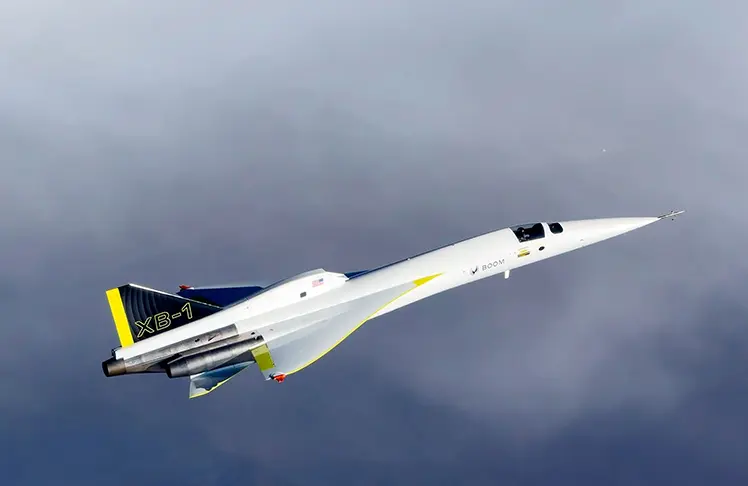
Although NASA and Boom partnered during one of the XB-1’s supersonic flights, with NASA providing waypoints to the company in order to photograph the plane as it broke the sound barrier, the space agency currently has no plans to investigate Mach cutoff using the X-59.
A NASA spokesperson told CNN that while the agency has done extensive testing on Mach cutoff in the past, the X-59 is designed to produce a sonic thump at its cruise speed and altitude every time it flies. Low-boom design and Mach cutoff are not in competition, the spokesperson added, but rather different approaches to commercial supersonic travel over land.
The good news for Boom, Coen added, is they don’t have to design an airplane to achieve Mach cutoff. But the technique in itself is not a slam dunk. Mach cutoff’s biggest limitation is that for it to work, a plane can only travel marginally faster than the speed of sound, typically Mach 1.1, or roughly 30% to 40% faster than current passenger planes — although Boom says the phenomenon is possible at up to Mach 1.3 speeds.
“It’s not going to be available in all weather conditions, because it’s very much dependent on the temperature distribution and the wind in the atmosphere,” Coen said. “On some days, you just won’t be able to fly at Mach cutoff speeds.”
However, he added, the new FAA rules and Mach cutoff create an opportunity to reintroduce supersonic flight. “I think that’s a very important step towards broader adoption of supersonic flight,” Coen said. “Eventually, I think, the next generation of supersonic airplanes would incorporate quiet sonic boom shaping technology, and eliminate the need for Mach cutoff flight, to use their full cruise speed over land and over water,” he noted, referring to what NASA is gunning for with the X-59.
Passenger potential
Boom has achieved Mach cutoff six times during two supersonic flights, it did so afterward and released no observational data. Mach cutoff wasn’t part of the original plan, according to Scholl. “We found it as we were going,” he said.
Initially, the company also aimed to launch transoceanic flights and outsource engine development. Now, after all major aviation manufacturers declined because they considered the endeavor too risky and niche, Boom is developing the engine in-house and plans to start with continental US routes instead.
The company achieved Mach cutoff with the Boom XB-1, making it the first privately developed jet to break the sound barrier. Boom retired the single-seat plane after just two supersonic flights.
Boom is currently working to produce a pre-production prototype of its Overture aircraft, which would eventually carry about 60 to 80 passengers at speeds of up to Mach 1.7 over water. That’s twice as fast as current airliners, allowing for a 3.5-hour flight time on routes such as New York to Los Angeles. The plane will be ready for passenger flights within four years, according to Scholl.
Because it’s much easier to design an airplane that does not have a low-boom shape, Mach cutoff will allow the introduction of supersonic flights more quickly, said Alonso, the Stanford University professor.
But he said the concept is not enabling the true benefits of supersonic flights due to its speed limitations. “The promise of supersonics is eventually to go Mach 2, maybe Mach 2.5 — if you want to be low boom at those conditions, you really have to look at other solutions.”
Mach cutoff also comes with an increase in fuel consumption. The engines are not in the ideal efficiency range at Mach cutoff speeds, and the technique requires more careful flight management to validate speed, altitude, wind, temperature, humidity and other parameters, he added. Nevertheless, Alonso said, Mach cutoff is “perfectly doable.”
According to Boom, the Overture plane will use up to three times as much fuel as today’s airliners. The company says Overture is designed to run entirely on sustainable aviation fuel, or SAF, an alternative to fossil fuels made from cooking oils and agricultural waste, which cuts carbon emissions by an average of 80%, according to the International Air Transport Association. However, adoption of SAF has been slow in the airline industry. Even though most emission-reduction plans are tied to the fuel alternative, production is expected to shrink year over year — and SAF remains below 1% of total fuel consumption.
Though the low-boom shaping used in the X-59 is not likely to be practical for a large airliner, and while the plane isn’t designed as an enabler for any particular class of aircraft, Alonso believes its design principles will apply more easily to smaller supersonic planes, in the business jet category of 15 to 20 passengers.
“I think it’s an incredible demonstration of something that could have tremendous impact in a different class of airplane than the one that Boom Supersonic are looking for,” Alonso said.
It’s hard to predict whether Mach cutoff and low-boom design will coexist, or if one will cancel the other out. According to Scholl, however, the world is not necessarily headed for a boomless future when it comes to supersonic travel.
“My expectation is people are going to find that even the full sonic boom is actually not a problem. I’ve heard a bunch of sonic booms, and the vast majority are no big deal,” he said.
“I think there could be a second wave of deregulation here that allows nondisruptive sounds, because that’s the environment we live in today. We don’t live in a perfectly quiet environment,” Scholl added. “There are thunderstorms. If we can go faster for a little bit of sound, I think there’s a good trade off there — but we’ll cross that bridge when we get there.”
The-CNN-Wire
™ & © 2026 Cable News Network, Inc., a Warner Bros. Discovery Company. All rights reserved.