
by Mekhi Abbott
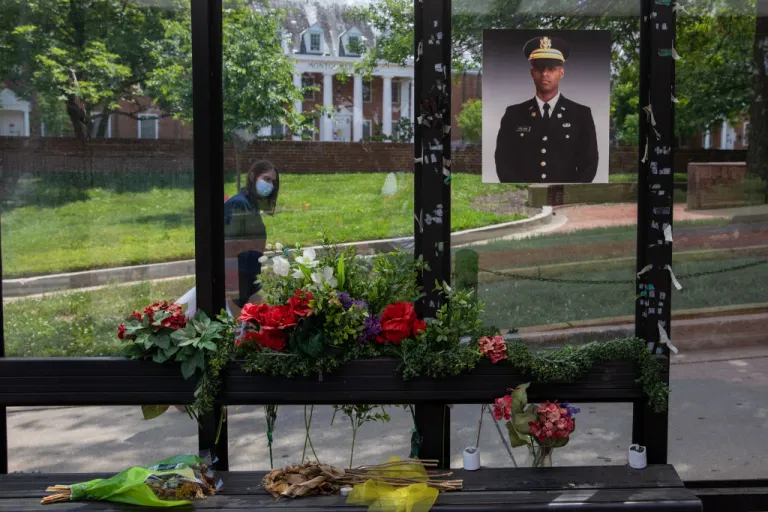
Eight years ago this month, Richard Collins III was a typical college student doing what college students do after a night out with his buddies: waiting for a ride home from the University of Maryland to his home campus, Bowie State University, an HBCU just a few miles away.
The night ended tragically, however, when Sean Urbanski — a white UMD student with a history of racist social media posts and rants — attacked Collins, a member of BSU’s Reserve Officer Training Corps, stabbing him to death while screaming racial slurs.
The murder left deep wounds on both campuses. At BSU, students were angry and frustrated at yet another Black man senselessly killed, while in College Park, where UMD is located, crime on the predominantly white campus consists mostly of stolen scooters and laptops; Collins’ murder was the city’s first since 2012. And it’s personal for me: I am Black, I am a UMD student, and, like Collins, I will graduate soon.
Yet every year since their son’s murder Collins’ parents have helped convene the BSU-UMD Social Justice Alliance Spring Symposium, an event that brings together members of both campuses as well as state, political and community leaders. Hosted by the BSU-UMD Social Justice Alliance, second lieutenant Richard W. Collins III Foundation and the UMD Anti-Black Racism Initiative, the symposium aims to address systemic racism, advance racial healing and identify ways that predominantly white institutions like UMD can better support its Black students.
“Our nation was founded on the premise that there is freedom and justice for all. But we all know in our hearts and through history that that promise is not often fulfilled,” said Rick Collins, Richard Collins’ father, speaking at this year’s symposium in April. “Justice has too often been delayed and denied, controlled by wealth and privilege. In a true democracy, justice is not impassive. It does not arrive on its own.”
The BSU-UMD Social Justice Alliance has committed itself to “eradicating the ideology of intolerance” and educating people to ensure social justice and equity for everyone. Collins’ murder sparked both universities’ ROTC programs to work together and create a diverse group of cadets, helping build community between the two schools. Under Armour, the Baltimore-based athletic apparel company, donated $250,000 to sponsor the initiatives.
Collins was set to begin his military career after graduation as an Army second lieutenant. After his death, the Pentagon granted him a posthumous commission.
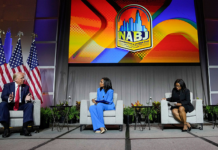
The symposium focused on social justice, democracy and civic engagement. The centerpiece was a panel discussion featuring policymakers and elected officials, including Maryland state Sen. Alonzo T. Washington; Nicole Austin-Hillery, president and CEO of the Congressional Black Caucus Foundation; and Karine Jean-Pierre, White House press secretary under President Biden.
The panel noted that, since President Donald Trump returned to power, there have been a seemingly relentless series of attacks on cultural, intellectual, and historical institutions that center on the Black experience in America. By extension, they said, it is also an assault on the institutional framework of democracy.
Although Sean Urbanski is serving life in prison for killing Collins, hate crime charges against him were dismissed due to lack of evidence. Still, Urbanski apparently had some enmity towards Black people and other minorities: the murder investigation found he participated in far-right Facebook groups, and had racist memes in his mobile phone.
Given Trump’s assault on diversity, the speakers said, it is easy for young people to feel hopeless and not know how to fight racism and division. But Washington, the Maryland state senator, said the stakes are too high for them to sit on the sidelines.
“I order for you to get engaged and get involved,” said Washington, who also called for increasing police diversity, getting rid of surplus military equipment sold to police departments and requiring officers to include restorative practices in their work.
“Everyone who works in my office is under the age of 25, I go around the county seeking young people to encourage them and put them in leadership positions,” he said.