

By Elisabeth Buchwald, CNN
(CNN) — On the surface, the Trump administration’s bet on immigration and jobs seems like simple math: If a swath of workers are removed from the country, employers will need to turn to the workers still in the United States to backfill those jobs.
That’s not what’s happening, though. American workers, citizen or not, are seeing slower wage growth, fewer job openings and a higher unemployment rate.
As it turns out, there are a lot of complicated factors keeping unemployed Americans on the sidelines. Chief among them is lower demand overall from removing people from the United States and stopping new immigrants from entering.
“In President Trump’s first year in office, all job growth went to American-born workers while job growth declined for foreign-born workers,” White House spokeswoman Taylor Rogers told CNN in a statement.
One million new jobs went to native-born workers, while foreign employment declined by 100,000 during Trump’s first year, according to Labor Department data. “The President continues to deliver on his promise to put American workers first,” Rogers said.
Less supply, less demand
Last year, between 200,000 and more than 1 million immigrants in the United States stopped working, according to different analyses of Census Bureau data.
The decline came as the Trump administration ramped up deportations and staged raids everywhere from car factories to Home Depot parking lots in search of people who entered the country illegally.
But as immigrants left the workforce, the unemployment rate for native-born Americans didn’t fall. In fact, the rate jumped to 4.7% in January from 4.1% the year before, according to Wednesday’s jobs report. That not only exceeds the overall unemployment rate of 4.3%, but also the 4.6% rate for foreign-born workers.
Meanwhile, January’s average hourly earnings for private-sector workers rose more slowly than last year.
Removing people from the country led to fewer workers and fewer people to buy the goods and services those workers produced, said Stan Veuger, a senior fellow at the conservative-leaning American Enterprise Institute.
“As net migration goes down and as deportations from the interior go up, you’re not just losing workers, you’re also losing people on the demand side,” Veuger told CNN. “You’re losing customers of businesses that hire workers.”
Jobs native-born Americans aren’t rushing to take
Even when jobs don’t get eliminated entirely due the immigration crackdown, that doesn’t mean more employment for the people who are left.
In some sectors, native-born workers aren’t necessarily rushing in for jobs, even if they’re currently unemployed, said Joe Brusuelas, chief economist at RSM.
“Immigrants are willing and able to do jobs that the overwhelming majority of our native-born population are simply not willing to do,” he said.
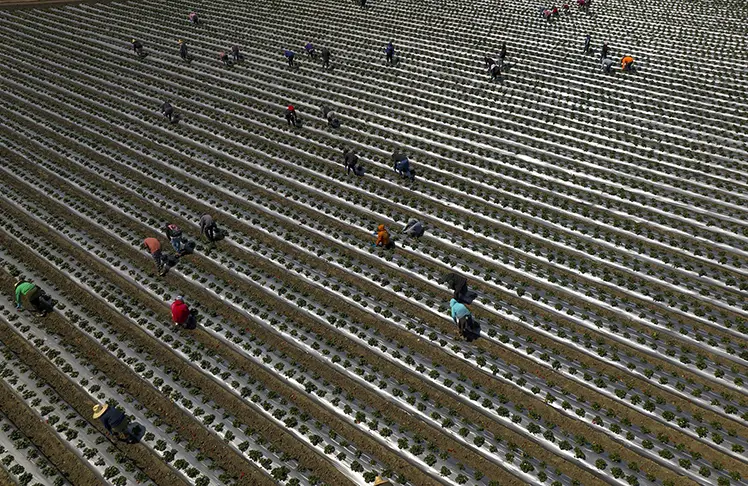
Agriculture, for example, relies on a labor force that’s mostly foreign-born. Nearly a quarter of all farming workers in 2023 were immigrants unauthorized to be in the country, according to an analysis published last year by Pew Research Center.
“It’s about a mixture of preferences, skills and advanced education among the native-born population that works against oversimplified ideas about creating artificial scarcity via labor supply that automatically preferences domestic-born workers,” Brusuelas told CNN.
Economic uncertainty is making employers hesitate
Tariffs are having an impact on employment, too.
“Trump’s trade policy, and even more importantly, trade policy uncertainty, is putting downward pressure on those industries,” said Wendy Edelberg, a senior fellow at the liberal-leaning Brookings Institution.
Given how frequently Trump changes tariff rates, employers have been hesitant to take on more workers.
In some sectors, they’ve had to resort to layoffs as well, in part because of the added expense of tariffs.
Manufacturing has taken an especially big hit over the past year, laying off nearly 100,000 workers. Firms have had to pay more for raw materials like steel and aluminum, which are being tariffed at 50%. They’ve also seen customers push off orders due to the higher costs.
AI is ramping up
Native-born American workers are also contending with employers looking for automated solutions, like AI, to deal with all those pressures.
The drive to improve productivity with AI is partly to blame for Amazon’s two rounds of massive layoffs over the past few months. And it’s hardly the only business.
In the Federal Reserve’s Beige Book, a collection of business anecdotes amassed by the 12 regional banks, the Boston Fed called attention to an IT services firm that “paused hiring plans as it considered using AI instead.”
The Atlanta Fed noted an even more widespread impact, saying, “several contacts described accelerating the use of AI to increase productivity and to manage head count.”
The-CNN-Wire
™ & © 2026 Cable News Network, Inc., a Warner Bros. Discovery Company. All rights reserved.