
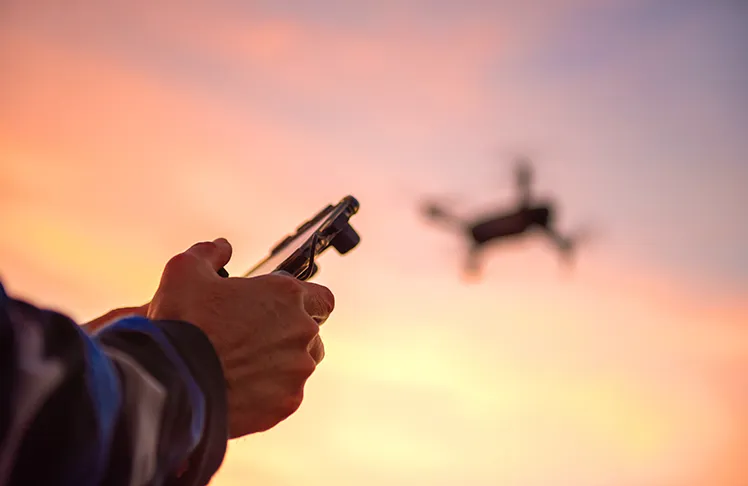
The U.S. House of Representatives recently passed the Wildfire Aerial Response Safety Act, a bipartisan bill led by Rep. Janelle Bynum of Oregon aimed at addressing the growing threat unauthorized drones pose to wildfire response efforts across the country.
The legislation, co-sponsored by Reps. Eli Crane of Arizona, Joe Neguse of Colorado and Juan Ciscomani of Arizona, seeks to improve the safety and effectiveness of aerial firefighting by directing the Federal Aviation Administration to study how drone incursions disrupt wildfire suppression and identify strategies to prevent interference in restricted airspace.
As wildfires grow more frequent, intense and year-round, emergency responders increasingly rely on aerial firefighting tools to slow the spread of flames, protect communities and support ground crews. But even a single unauthorized drone entering restricted airspace can bring those operations to a halt.
When drones are detected near an active wildfire, aviation safety rules require all firefighting aircraft to be grounded to avoid the risk of collision. These delays can stop critical water drops, disrupt reconnaissance efforts and increase the danger for firefighters and nearby residents.
In Oregon and across the country, such incidents have become more common. During the 2025 Flat Fire, a recreational drone delayed the initial aerial response by nearly 30 minutes—time officials say is often critical in containing a fire before it spreads.
Federal data highlights the growing scope of the issue. Drone incursions have been reported in multiple states and, in several cases, have forced the suspension of aerial firefighting operations, delaying suppression efforts and increasing costs.
“Earlier this year, a drone delayed the aerial fire response to the Flat Fire in Central Oregon,” Bynum said. “That’s why I introduced the Wildfire Aerial Response Safety Act to put the safety of our forests, our firefighters, and our airspaces over random drones in the sky.”
Bynum said the legislation is intended to ensure that wildfire response operations remain fast, coordinated and safe, particularly as communities across the West continue to face increasingly destructive fire seasons.
In remarks on the House floor, she emphasized that wildfires are no longer seasonal events, but year-round threats that are growing more intense and dangerous. She pointed to Oregon’s devastating 2020 wildfire season, when more than one million acres burned and entire communities were displaced, as a reminder of the importance of rapid and uninterrupted response efforts.
A key component of the bill is a directive for the FAA, in coordination with other federal agencies, to conduct a comprehensive review of drone interference over the past five years. The study will examine how often drone incursions occur, how they affect response times and suppression efforts, and the financial costs associated with delays.
The legislation also calls for an evaluation of potential solutions, including new technologies to detect or disable unauthorized drones, as well as public education campaigns to raise awareness about the risks of flying drones near wildfire zones.
Supporters say the bill builds on earlier federal efforts to address drone interference while adapting to the rapid growth of consumer drone use, which has made incidents more frequent and more difficult to manage.
Ultimately, lawmakers say the goal is simple: ensure that firefighters and emergency responders have the tools, visibility and airspace they need to act quickly and safely when lives and property are on the line.
The bill now moves to the Senate for consideration.