
This article is part of “On Borrowed Time” a series by Anissa Durham that examines the people, policies, and systems that hurt or help Black patients in need of an organ transplant.
Every day across the country, people renew or apply for driver’s licenses. Toward the end of the form sits a deceptively simple question: Are you willing to register as an organ, eye, and tissue donor?
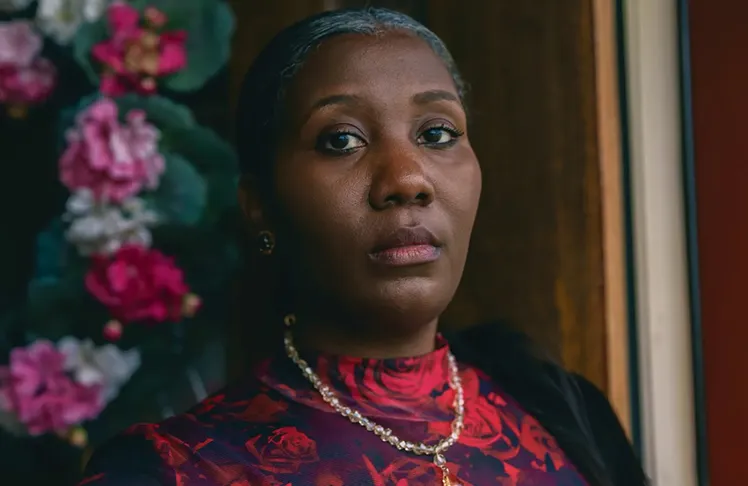
For 40-year-old Tamika Smith, the answer is obvious: no.
“I have my yearly, I get my checkups, I stay on top of my preventative care, but I don’t trust them,” she says of the medical system. “I don’t care what the race of the doctor is, I don’t trust them.”
Her refusal to become an organ donor comes from her personal experience. And to understand her answer, you have to understand what the medical system has already taken from her.
The Making of Mistrust
By the time she turned 34, Smith had spent most of her life in pain — and being told by doctors that her pain wasn’t real.
On Jan. 31, 2019 — her birthday — the New Orleans native wasn’t out celebrating. She was vomiting in the bathroom, doubled over from pelvic pain, and unable to speak due to a crippling headache.
Smith spent about three weeks of every month like this, which left her unable to eat, sleep, or go to work. Her teenage son, Daniel, had grown up placing cold compresses on her forehead and preparing hot herbal tea — a child caring for a parent the medical system refused to take seriously.
For more than a decade, Smith tried to get answers. She kept meticulous notes in a black binder, along with photos, videos, and audio clips. Appointment after appointment, Smith shared her evidence. Appointment after appointment, she was dismissed.

Doctors tested her for sexually transmitted infections, put her on various forms of birth control, suggested a hysterectomy, and floated the idea that pregnancy might “cure” her. When nothing helped, they told her it was all in her head.
But the pain had been going on since she was a child.
“I would get so weak, I would get so dizzy,” she says. Smith often missed as much as two weeks of school at a time. Her mother, Rita, kept evidence of her illnesses so that Smith wouldn’t be considered truant, which would have landed them in family or juvenile court.
Rita had endometriosis, a condition that causes the uterine lining to grow outside of the uterus, and endometrial cancer in her 20s. Still, doctors insisted Smith was too young to have the same condition.
Nine gynecologists later, the diagnosis finally arrived: endometriosis. And a year after that, she was diagnosed with lupus.
“I’ve never had a relationship with a man where somebody just dogged me out and dragged me through the mud or left me on the highway. I’ve dealt with that in the health care system,” the now 40-year-old says. “What women say about how men treat them, it’s the same with the health care system. It’s toxic.”
Smith realized she had been a victim of medical gaslighting and dismissal of care. And that realization, she says, drives her choice when she sees that organ donation question on the DMV form. Her mistrust — of doctors and medical institutions — is personal. But it’s also widely shared.

Can You Blame Them?
In a Verywell Black Health Experience survey, Black and white Americans use health care at nearly identical rates, but the quality of those experiences varies significantly. Of Black patients who reported experiencing racism while seeking health care, 52% said it happened during the appointment itself.
In September and October, Word In Black’s Insights & Research Division surveyed 1,588 Black adults on their views on organ donation and transplantation. 57.6% of respondents said they do not believe Black patients are treated with the same respect and dignity as other transplant patients.
Dr. Christa Mahlobo, director of the Insights & Research Division, cautions that although the responses provide “valuable insight into how Black Americans think and feel about organ donation and transplantation,” they aren’t nationally representative. “The survey was distributed through Word In Black’s publisher network and related partners, and participation was voluntary.”
As a result, respondents “skew older, more female, and higher SES — in terms of education and income — than the broader U.S. Black adult population,” Mahlobo says. Essentially, the survey data reflects the “perspectives of older, more engaged, or more health-aware readers” who are more likely to have an advanced degree and earn over $100,000.
To understand why distrust of organ donation and transplantation exists in the Black community, educators, scholars, and physicians point to America’s long track record of medical racism and mistreatment of Black bodies: the U.S. Public Health Service Tuskegee Study of Untreated Syphilis in the Negro Male; Henrietta Lacks’ stolen cells; James Marion Sims — considered a pioneer in gynecological medicine — experimented on enslaved Black women, like Anarcha, Lucy, and Betsy, without anesthesia.
But Lillie Williamson, an assistant professor of communication science at the University of Wisconsin-Madison, argues that framing mistrust solely through the lens of historical harm lets modern medicine off the hook.
“If we continue, in 2025, to point to that, it allows people to situate it as a historical event. Like ‘Oh, we’ve come so far, that would never happen today,’” Williamson says. “Yes, there is that event, but it’s also a constellation of things.”
This year alone, a white nurse was arrested for breaking the bones of NICU babies in Virginia, a brain-dead Black woman was kept on life support to be an incubator for her baby in Georgia, and a Black mother in active labor was ignored at Dallas Regional Medical Center while a white nurse typed on the computer next to her.
Williamson co-authored a report on Black Americans’ general perceptions of organ donation that details how participants in focus groups cited the usual concerns about registering as a donor: a lack of knowledge on the issue, negative personal experiences with donation, and bodily integrity.
But one barrier to registration outweighed all others: mistrust.
In her research, mistrust is more about the real-life experiences Black people have had, and it’s often a response to oppression and marginalization. The same institutions that surveil, arrest, and neglect Black Americans are often the same ones they’re expected to trust in a medical crisis. For example, in June 2020, a Minneapolis police officer murdered George Floyd when he held his knee to Floyd’s neck for more than nine minutes, even as Floyd should have been given medical care when he said he couldn’t breathe.
“The medical system is just one of many institutions that were not built for persistently marginalized communities, and particularly Black communities,” Williamson says. “That’s where the government piece comes in. It’s why we know there’s a relationship between police violence and medical mistrust. Things spill over across systems because they’re reminders of the ways in which these systems were not built for [us].”
Where Does the Onus Lie to Rebuild Trust?
It’s not uncommon to hear Americans of all races and ethnicities say they don’t trust the organ donation system. But the stakes for Black Americans are uniquely high. They have higher-than-average rates of chronic diseases that often lead to the transplant waiting list, like high blood pressure, diabetes, and obesity.
Despite making up only 13% of the population, Black Americans account for roughly 30% of people waiting for a kidney.
Needing a kidney — or knowing someone who needs one — doesn’t magically make mistrust go away, though. In particular, many Black folks believe that doctors will not work as hard to save a Black person’s life if they are a registered organ donor and in the hospital in critical condition.
Dr. Anthony Watkins, surgical director of the kidney and pancreas transplant program at Tampa General Hospital, has heard this myth throughout his entire career. Although organ procurement organizations, transplant recipients, and transplant surgeons have been fighting this belief for years, it persists.

As a physician of color, Watkins has been very intentional about educating his patients: visiting churches and dialysis centers, and helping non-Black colleagues address the misinformation and mistrust in the Black community.
“The burden lies on everyone,” he says.
That includes medical organizations, organ procurement organizations, physicians, and hospitals. It also requires addressing systemic inequities that contribute to mistrust and making targeted efforts to increase diversity in the health care workforce.
“The challenge is that health care systems are a microcosm of America. To address the health care issue, you have to address the societal issues,” Watkins says. “It’s very complicated. But it’s something we can never stop working towards improving and rectifying.”
The Faces Behind the Fear
Justin Paige, a 31-year-old who goes by “Cut,” says his hesitation around organ donation comes from a preference for holistic practices over traditional Western medicine.

Paige, an artist and co-owner of a seeded watermelon company, says his work is based on healing wounds within and generational trauma. Through his healing journey, he began to step away from America’s health care system. He read about instances of malpractice, the booming business of pharmaceutical companies, and the ways Black bodies have been mistreated.
“They kind of push it in our face that they don’t care about us,” Paige says. “So, from the research I’ve done this far, it urges me not to be connected to [organ donation].”
It’s not just about the harm the U.S. health care system has inflicted on Black people, he says. It’s about the cumulative effect of systemic racism and the experiences that come with it: the lack of fresh produce, redlining, the quality of school lunches, overpolicing — in short, the “weathering” effects of racism-related stress. When asked if there’s a way to heal these longstanding wounds, he says an apology and the complete reconstruction of these systems would need to happen.
Can You Move Past Mistrust?
Kelsey Russell, 25, knows the myths about organ donation, but they haven’t stopped her from being a registered organ donor. The full-time social media literacy influencer and podcast host of Kronikled, spends her days teaching people how to vet information. The health care system has its issues, she says, but it’s not fair to let misinformation diminish the advancements in medical research and medicine.

“You might know somebody who may need an organ donation one day,” she says.
Russell’s father donated a kidney to his brother 20 years ago, an experience that shaped her views on organ donation. And she encourages people to ask appropriate sources — like a primary care physician, living donor, or transplant recipient.
“If you’re already thinking that’s something ‘I don’t believe in or I don’t trust that’ you could miss out on the opportunity to save somebody’s life. Or for someone to save your life,” she says.
Mistrust of the health care system doesn’t form overnight.
Williamson, the medical mistrust researcher, says when Black people have negative health experiences in clinical settings, they often turn to online sources, family, friends, and elders in the community. The problem is, this is where misinformation can take root. For example, the idea that doctors will prematurely declare someone dead to “harvest their organs” shows up in television shows and movies and is commonly spread by word of mouth.
The fact is, it’s not true.
Here’s why: less than 1% of people die in a way that would qualify them as deceased organ donors. And the health care team that declares someone brain dead is not the same team that would prepare someone for donation.
The Emergency Medical Treatment and Labor Act, a federal law, requires hospitals to provide emergency medical services and stabilizing treatment to anyone who enters the emergency room — meaning, it’s unlikely emergency medical teams would immediately know whether a patient is a registered donor when the priority is to stabilize them. And every registered donor can select which organs they are willing to donate.
And Williamson pushes back on the idea that it’s impossible to change someone’s beliefs on organ donation.
“It’s possible to hold mistrust and still do things with it,” she says. “Just because people are mistrustful doesn’t mean they won’t ever donate their organs. It’s not a stopping point.”
A Body at its Limits
In March 2021, Smith was getting her hair braided when she felt her legs giving out. She got up from the stylist’s chair and nearly fell. That morning, she promised her son Daniel she would pick him up from work. The plan was to go home and watch movies together. That’s when she felt her left leg dragging.
“I knew something was taking place, but I was in denial. I was in a fight-or-flight mode,” she says through tears. “My son. I’m a single Black mom. I gotta make it.”

Tamika picked her son up and drove to her parents’ house. She barely made it inside. Her mom called 911. Three paramedics came and activated a stroke protocol. When she arrived at the hospital, doctors started the countdown. Patients typically have about 4.5 hours before brain damage occurs.
But it wasn’t a stroke. It was her recently diagnosed autoimmune disease, lupus, whose symptoms mirror endometriosis.
Tamika spent the next several months in and out of the hospital. Her mobility deteriorated. She couldn’t hold her head upright. Then came tremors and chronic headaches. A few weeks later, she caught a viral infection after taking an immunosuppressive medication.
“I was told I had less than six months to live,” she says.
Then, in August 2021, she had another near-death experience from an allergic reaction to a different medication. At home, she needed to use a wheelchair and a shower chair. Eventually, she reached a breaking point and decided to get off all medication. Instead, she incorporated ginger, turmeric, and medicinal herbs into her diet. Mushrooms for brain health. She ate sea moss gel, known for its anti-inflammatory properties, and stuck to a strictly alkaline vegan diet.

Eight months later, she walked again.
In response to her experience, Smith published an ebook “The Most Toxic Relationship I Ever Had: Surviving Medical Gaslighting, Loss and My Path to Healing.” And she organizes a monthly community support group for those affected with chronic illness.
“All these things have truly traumatized me,” she says. “I tread very lightly in the health care system. I don’t have this codependency mindset that they’re going to heal me.”