
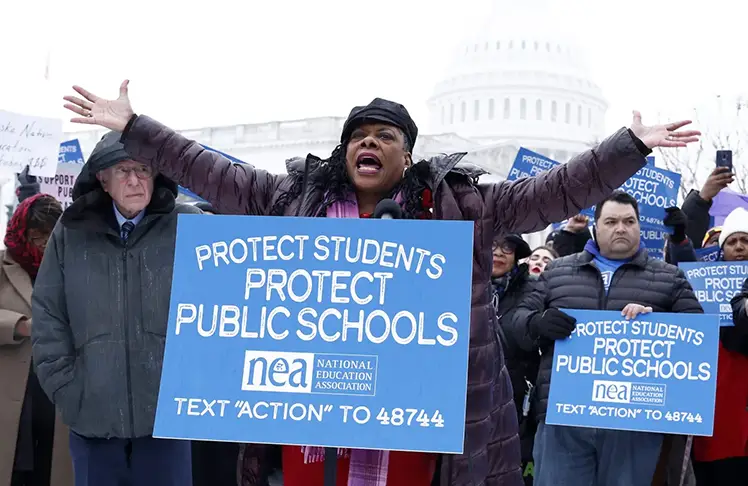
Attacks on DEI. Black students under AI surveillance. ICE raids are disrupting schools. This year was chock-full of stories that revealed the pressures facing K-12 students and schools.
If you missed some of the consequential education stories of 2025, here’s a recap to get you up to speed — and you can count on some of these issues showing up in 2026, too.

1. DEI Rollbacks in K-12 Schools
The Trump administration has made diversity, equity, and inclusion programs its top target for attack. The administration claims they are discriminatory, but a plethora of research and studies prove that they are key to making sure Black children succeed in schools. If schools can’t create policies to narrow the Black-white opportunity gap, then Black students could further fall through the cracks, experts say.

2. Schools Still Need to Do Right By Black Boys
School can be rough, especially for Black boys, who are more likely to face suspensions, expulsions, and be placed in special education. As a result, many of these Black boys end up dreading school, says Dr. David E. Kirkland, CEO of ForwardED. He, and many scholars like him, believe that schools aren’t doing enough to engage with Black boys properly — a factor that contributes to them forgoing college.

3. AI Surveillance and the School-to-Prison Pipeline
Public schools are using artificial intelligence technology, including face recognition cameras, vape detectors, and predictive analytics software, to identify “high-risk” students. But advocates say that this very same technology is being deployed in majority Black and low-income schools, and could quietly expand the school-to-prison pipeline.

4. Black Students Need More Mental Health Support
More than 40% of Black children between the ages of 13 and 17 have considered suicide in the past year, according to a new report from The AAKOMA Project. Racism in the public schools can often chip away at a young person’s sense of safety and self-worth, the report says. But researchers say school districts can reverse the trend by providing services that address Black students’ sociological and cultural needs, as well as by creating a welcoming and inclusive learning environment that supports the mental and emotional needs of all students.

5. More Black Teachers Plan to Quit the Classroom
The president of the National Education Association, Becky Pringle, told Word In Black she worries the teaching profession is growing less diverse by the year. She’s not wrong: a RAND Corporation survey found that 28% of Black teachers, citing low pay, lack of respect, and burnout, planned to quit by June 2025. That’s about double the share of white teachers who planned to walk away.

6. ICE Raids Are Wreaking Havoc in Schools
President Donald J. Trump’s immigration crackdown is disrupting the nation’s K-12 education system. The spike in Immigration and Customs Enforcement raids across the country — particularly in cities like Chicago, Houston, and Atlanta — has exposed Black and Brown K-12 students to shock tactics and violence, making them fearful of going to school, advocates say. In Chicago, ICE agents raided an apartment in the Southside neighborhood of the city. A day later, a nearby school saw a heavy drop in its attendance.

7. Trump’s Hatchet Job at the Education Dept.
Since taking office in January, President Donald J. Trump has prioritized a big campaign promise: dismantling the Department of Education, which helps ensure Black students and other disadvantaged groups have equal access to a quality K-12 education. In mid-November, the Trump administration announced that it had shifted several of the department’s key responsibilities to four other federal agencies, including the Department of Labor. Advocates for equity in education criticized the decision, saying it could widen the Black-white opportunity gap.

8. Saying Goodbye to Dr. Rod Paige
He was the first Black education secretary, and the architect of No Child Left Behind, the Bush administration’s much-maligned education policy. But Dr. Rod Paige, who died at age 92 on Dec. 9, believed student achievement comes through setting high standards. He served as the first Black superintendent of the Houston Independent School District
When former President George W. Bush chose him to lead the Education Department, Paige seized the opportunity. He rolled out the No Child Left Behind Act, which focused on testing and sanctions for K-12 schools. After his time in the department, Paige went to lead his alma mater, Jackson State University, as the school’s interim president.