

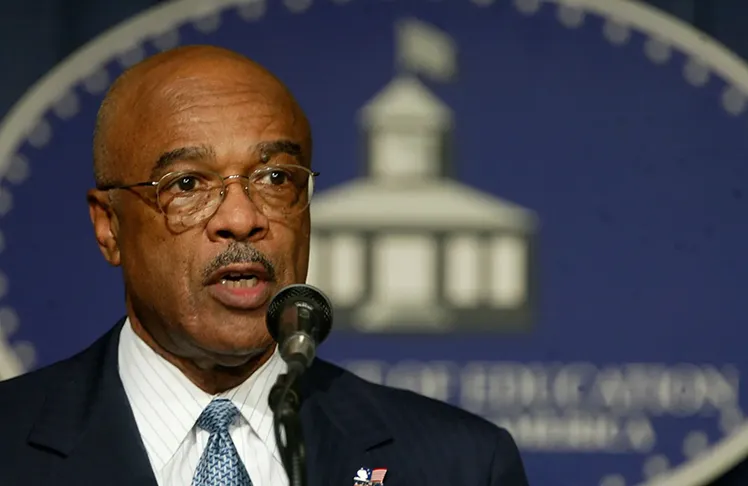
Rod Paige died Tuesday at 92, leaving behind a legacy as complicated as education reform itself. The nation’s first Black Secretary of Education, Paige was both a barrier-breaker and a lightning rod — the architect of the controversial No Child Left Behind Act, which promised to revolutionize how America taught its children, but instead became a cautionary tale of high-stakes “drill and kill” testing and pressure on schools to improve scores.
Born Roderick Raynor Paige in 1933 in segregated Monticello, Mississippi, to a librarian mother and a school principal father, Paige followed in his parents’ footsteps. He earned a bachelor’s degree from Jackson State University before heading to Indiana University Bloomington, where he earned a doctorate in physical education.
He returned to Jackson State as head football coach, then moved to Houston, Texas, where he coached at Texas Southern University, eventually becoming dean of its College of Education. There, he created the Center for Excellence in Urban Education, channelling his interest in improving school systems.
The Houston Miracle
But it was the Houston Independent School District that really became Paige’s laboratory. After becoming HISD’s first Black superintendent in 1994, he brought in business leaders to advise on school support services. Paige created charter schools, increased teacher pay, and made HISD the first school district in Texas to tie teacher employment to results. Test scores climbed. The “Houston Miracle,” they called it. Former President George W. Bush, then Texas governor, took notice.
What happened next — both in Houston and later in Washington, D.C., would come to define Paige’s career and legacy. Bush tapped Paige for Secretary of Education in 2001 and charged him with scaling up what worked in Houston. Paige set out to end what Bush called “the soft bigotry of low expectations” for students.
“The easiest thing to do is assign [students] a nice little menial task and pat them on the head,” he told the Washington Post in an interview in 2001. “And that is precisely what we don’t need.” The man who triumphed despite Jim Crow believed this approach “may be our greatest gift: expecting them to achieve, and then supporting them in their efforts to achieve.”
The Rise — and Fall — of No Child Left Behind
The result was No Child Left Behind, which became law in 2002. It seemed straightforward: test students annually in reading and math in grades 3 through 8 and once in high school to receive federal funding. Report the results to the government and break them down by key demographics (race, income level, disability, etc.) to identify achievement gaps. And NCLB mandated schools reach 100% proficiency on state tests by 2014 — or else face escalating sanctions, including closure.
For Black communities, the stakes of Paige’s reforms were especially high. NCLB exposed long-ignored achievement gaps by forcing the transparent reporting of test results, thus exposing how poorly many districts were serving Black students. But NCLB concentrated its harshest consequences on these chronically underfunded, underresourced districts — places where structural racism couldn’t be fixed by a Scantron form.
Cracks appeared in 2004, when the “Houston Miracle” revealed itself to be partly a mirage. A CBS News investigation found HISD schools underreported the number of dropouts, inflating their apparent success.
And under NCLB, each state got to define “proficient” for itself, leading to inconsistent achievement standards nationwide. Parents, educators, and community activists pushed back against policies that overly focused on testing and set unrealistic goals, coupled with severe punishments. Indeed, by 2014, not a single state had achieved the statistically impossible 100% proficiency.
A Mixed Record That Still Shapes Schools Today
There were some silver linings to NCLB, though. A 2009 analysis showed strong gains in math performance. Teacher pay also increased, along with the percentage of teachers with graduate degrees. But educators agreed the costs — narrowed curricula, high-stakes testing culture, demoralized teachers — outweighed the gains.
The Every Student Succeeds Act replaced No Child Left Behind in 2015.
By then, Paige had long since left Washington. In 2016, the former secretary returned to his roots at Jackson State University, where he served as interim president from 2016 to 2017.
“Rod was a leader and a friend,” Bush wrote in announcing Paige’s death. “He devoted his life to America’s young people and made a difference.” Whether that difference is positive remains a question educators are still debating. What’s certain, though, is that Paige believed deeply in setting high educational standards for children.
Paige is survived by his wife, Stephanie Nellons, and their two children.