
By Matt Villano, CNN
(CNN) — In the middle of an intense workout, Kristina Lazzaro stepped back and heard a sound like a cork coming out of a bottle of champagne.
The 35-year-old Buffalo, New York, resident was doing a partner workout at her local gym, pushing herself to finish strong on a shuttle run in which runners sprint from one line to another and back.
Lazzaro exploded off the first line. Arms pumping, she dashed 10 yards across the gym to the other line. As she put her foot down to pivot, she heard a popping sound and crumpled to the floor — unable to move her foot at all.
“I ended up on the ground, and I didn’t know how I got there,” she said. “There was no warning, no symptoms, and nothing that suggested something like this could happen.”
Lazzaro later learned she had ruptured her Achilles tendon — a part of the body named after a famous character of Greek legend. It’s a brutal injury with recovery time that can last up to a year. She sustained the injury on February 6, and she’s still undergoing physical therapy.
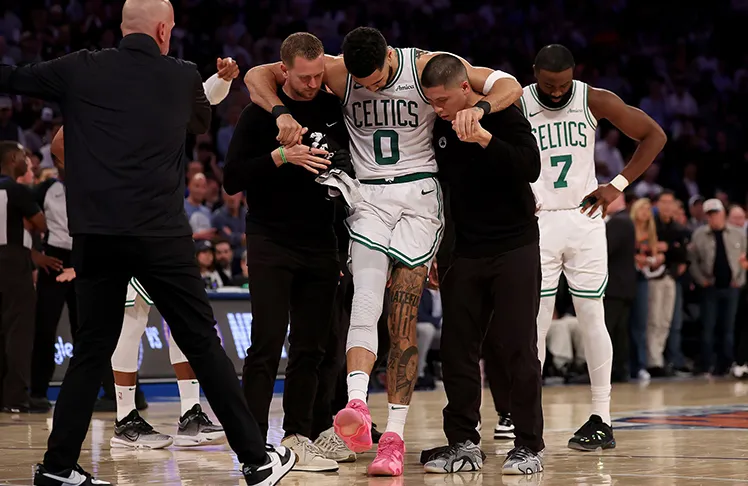
It seems Achilles injuries are plaguing ordinary fitness buffs and some of the world’s best athletes these days. Actor Sterling K. Brown showed up to this year’s Emmy Awards on a knee scooter after shredding one of his. Achilles ruptures also decimated the 2025 NBA playoffs, befalling stars such as Indiana Pacers point guard Tyrese Haliburton, Boston Celtics forward Jayson Tatum and then-Milwaukee Bucks point guard Damian Lillard, who now plays for the Portland Trail Blazers.
Recent data suggests the injury is rare — about two cases for every 100,000 people who checked into US emergency departments between 2001 and 2020, according to an August study — but podiatrists and orthopedists said they’ve seen a significant uptick in the number of cases in the last few years, especially among people 40 and older.
This increase troubles Dr. Priya Parthasarathy, a podiatrist in Silver Spring, Maryland.
“We’re seeing more and more of these because greater numbers of older people are demanding explosive-style workouts,” she said. “With the Achilles, it’s all about gradual load. Anything else could be dangerous.”
The tendon that’s the stuff of myths
The calcaneal tendon was named the Achilles in 1693 by Flemish anatomist Philip Verheyen as a reference to the mythological Greek hero, whose only vulnerable spot was his heel. It is the longest and strongest tendon in the body. From a physiological perspective, it connects the calf muscles to the heel bone. Biomechanically, the tendon can withstand forces up to four times a person’s body weight.
The Mayo Clinic notes that the tendon is critical because it allows for plantar flexion of our feet, the ability to point toes downward. Plantar flexion makes it an essential part of our ability to walk, run and jump, according to Dr. Michael Alaia, a professor in the department of orthopedic surgery at New York University Grossman School of Medicine.
“You can’t really move around without engaging your Achilles,” he said. “Anything where you start and stop rapidly, or even when you’re coming down from a jump, the Achilles will feel some stress.”
As a result, the tendon is in constant use, which, according to the Cleveland Clinic, means it can naturally weaken over time.
Recent research indicates such degeneration can be a huge factor in Achilles ruptures. As people age, their tendons lose elasticity and become brittle, creating a situation in which the wrong move at the wrong time can lead to catastrophe.
Men between the ages of 35 and 50 are particularly susceptible, Alaia noted.
Other conditions make the Achilles more prone to rupture as well.
A 2024 study in the Journal of Sport and Health Science suggested that the certain antibiotics in the fluoroquinolone class — such as ciprofloxacin — carry a “black box” warning from the US Food and Drug Administration for tendon problems, including Achilles tendon rupture, especially in older patients or those who take steroid medications.
Add to the mix other factors such as obesity, poor conditioning and exercise overload on the part of “weekend warriors” who work out hard on Saturdays and Sundays, and the risks of rupture multiply exponentially.
How to minimize risk
Unfortunately, especially if you’re in the 35- to 50-year-old demographic, there’s nothing you can do to prevent an Achilles tear.
Still, the best way to avoid one is to minimize the risk. According to Alaia, you should stretch before activity, listen to your body, allow for time to rest between workouts, keep yourself hydrated, get good sleep and abstain from smoking cigarettes.
Parthasarathy added it’s also important to invest in good shoes, gradually increase the intensity of workouts and strengthen the muscles around the Achilles to relieve some of the load that the tendon typically carries. To strengthen those muscles, she recommends using a balance board, or participating in regular yoga classes.
“Anything you can do to slow down is going to put you at less of a risk,” Parthasarathy said. “The very last thing you want to hear in a workout is that pop.”
The dreaded step back
Perhaps the most common trigger for an Achilles tear is the so-called explosive movement. On the basketball court, it could be as simple as a sudden change in direction. On pickleball or tennis courts, it could arise from moving suddenly to return a smash.
Doctors agree that the most dangerous motion for an Achilles is the step back.
Often, according to Parthasarathy, this move puts incredible pressure on the Achilles in the leg that’s dropping back — pressure that could snap the tendon if it is compromised in any way.
This movement is precisely what spelled doom for professional hoopsters Lillard, Tatum and Haliburton this year. NFL fans might remember that the step back is what felled quarterback Aaron Rodgers four snaps into his debut for the New York Jets in 2023.
It’s also what left Lazzaro collapsed on her gym floor.
Sometimes, however, other seemingly innocuous motions can trigger a serious Achilles rupture.
In the spring, Kevin Mullins, 40, of Boston played in an alumni lacrosse game in Maine. No more than 10 minutes into the action, the former Bowdoin College athlete was running down the field at about 50% speed, and his Achilles gave out. One second, he was fine. A second later, he felt like someone had shot a ball at his calf and he couldn’t move.
“It was the craziest thing because there was absolutely no pain,” Mullins said. “I was aware that more people have been getting this injury. I just never thought it would happen to me.”
It’s a long road to recovery
Doctors diagnose a torn Achilles with the help of something called the Thompson Test. Patients lie face down with their feet dangling over the edge of the examination table. Doctors then squeeze the calf muscle of the injured leg.
In healthy legs — those with an intact Achilles — a squeeze of the calf will trigger plantar flexion, and the toes will point downward. In legs with a ruptured Achilles, a squeeze of the calf will do nothing.
“The Thompson Test makes it pretty obvious” that someone has ruptured their Achilles, Alaia said, noting that some doctors will use an ultrasound machine or get an MRI before an official diagnosis.
There are two main treatments once a rupture has been confirmed: surgical and nonsurgical intervention. To determine which option to recommend, doctors typically will consider whether the tear is full or partial, and what sort of fitness level the patient seeks to regain once the injury has healed.
Frequently, surgery is offered to repair full tears in patients who wish to return to competitive sports. A 2024 meta-analysis in the journal Frontiers in Surgery indicated that the benefits of surgery are simple: Repaired tendons are stronger, they rerupture less frequently, and they allow for a quicker return to sports. However, a 2023 study in the Canadian Journal of Surgery suggested that nonsurgical options can have encouraging results, too, despite a longer road to recovery and a slightly higher rerupture rate.
Months of rehab
However a patient decides to treat an Achilles rupture, two things are certain: no driving for at least a month after the injury (additional time if it’s the right Achilles) and lots of rehab.
Most patients start their recovery in a cast to immobilize the tendon and give it time to heal. Past protocols required immobilization for months; research suggests that the introduction of light weight-bearing activity around the third week after injury can slow the development of scar tissue and accelerate the healing process.
Rehab philosophies differ widely from there.
Most doctors prescribe several weeks in a walking boot, followed by slow and steady physical therapy that starts with gentle stretches and eventually moves into restriction-free, weight-bearing exercise.
Others, such as Dr. Chris Smith, a doctor of physical therapy in West Islip, New York, take a more aggressive approach.
Frustrated by the methods of most rehab programs, Smith launched the Achilles Rebuild, a program that aims to get people comfortable and confident with getting back to exercise as soon as possible. Smith works with clients virtually; he has weekly consultations with them and sends them lists of exercises to do.
“The traditional approach to rehab is protocol-based — they’re making decisions based on a timeline they have for everyone,” he said. “The truth is that every person recovers differently. Building a program around performance metrics is much more sensible.”
The-CNN-Wire
™ & © 2025 Cable News Network, Inc., a Warner Bros. Discovery Company. All rights reserved.