
At 17, Kaelin Banks is already a veteran of public comment. The rising senior at UCLA Community School remembers how nervous she was the first time she spoke at a Los Angeles Unified School District board meeting.
“I was scared, but the feeling after was just far more fulfilling than anything,” says Banks, now a leader of the youth-led activist group Students Deserve. It “gave me that motivation to use my voice.”
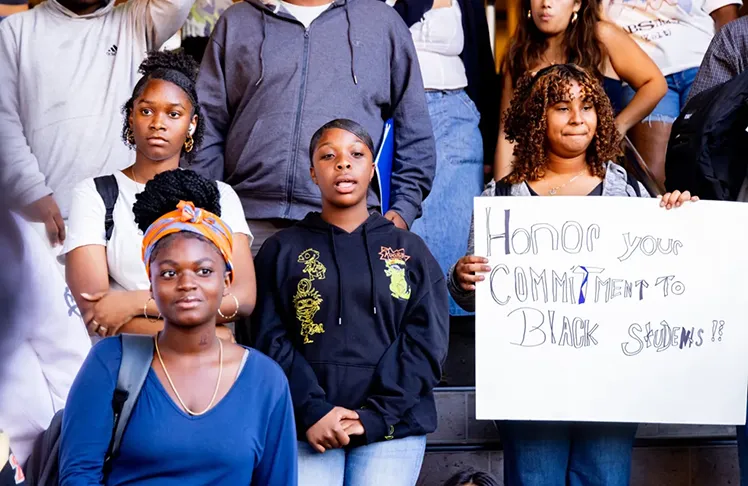
Across Los Angeles, youth like Banks, who are involved with Students Deserve — along with the families and educators who support them — are speaking up to defend Black students’ right to a full, accessible, public, nonviolent education environment. And they’re doing so in an era when conservative groups are suing districts for addressing racial inequities, and the Trump administration is gutting the U.S. Department of Education.
In 2024, LAUSD eliminated race as a factor in determining student support following a federal civil rights complaint from a Virginia-based conservative group against the Black Student Achievement Program. Launched in 2021, BSAP provides academic, emotional, and mental health resources to K-12 schools with large Black student populations.
Despite the legal pressures, in June, the Police Free LAUSD Coalition, which includes organizations like Students Deserve, Reclaim Our Schools, and the Collective for Liberatory Lawyering, celebrated the district making a $50 million reinvestment in BSAP.
Students spoke out “about what BSAP means to them and how it makes a really big impact on their lives,” Banks says. At a “Put the Black Back in BSAP” rally Banks helped organize, students “chanted outside of the school board and we made sure to make noise so that they couldn’t just ignore” the youth.
Fighting for Their Kids
For parents like Kenyetta Gray, a mother of six, the fight is personal. Frustrated by being ignored at her children’s schools, she joined Reclaim Our Schools LA after meeting an organizer at a BSAP-led Black History Month pep rally in February.
The group, which works to ensure racial justice in public schools, gave her “the strength and the ability to speak up more and not be silent about certain situations when it comes to us,” Gray says.
Gray says BSAP has offered her kids invaluable support — from field trips to conversations with mental health professionals. Indeed, along with counselors and psychiatric social workers, BSAP offers school climate coaches, restorative justice teachers, and math and literacy support.
Gray says BSAP keeps her kids “wanting to go to school” and she plans to stay involved.
“This is something that can save my children’s life,” Gray says. “We live in L.A. The streets are rough out here.”
She’s also urging other Black mothers to get involved and shape BSAP. “I’m going to do everything I can to speak up and advocate,” she says.
Legal advocates like Ashleigh Washington, director of education justice at the Collective for Liberatory Lawyering, are equipping the community to fight back — demystifying the law and teaching how to support Black children and dismantle the school to prison pipeline. Washington trains folks how to file records requests, investigate data, and respond to legal threats, like the one that pressured LAUSD to drop race as a factor in BSAP.
That challenge argued BSAP violated Title VI and the equal protection clause of the 14th Amendment by meeting the needs of Black students. Washington says that argument misrepresents the law.
“It’s not illegal,” she says. “To remedy discrimination, the district has an affirmative obligation to remedy past and present discrimination.” Targeting resources to Black students directly responds to that.
I don’t believe in losing hope.
Kaelin Banks
The next step, Washington says, is engaging with LAUSD’s BSAP steering committee and continuing to hold the district accountable for how the $50 million is spent.
“We are trying to change the hearts and minds of folks,” she says.
When Banks, the rising senior, heads back to school in August, she wants to recruit more students to join Students Deserve and speak at school board meetings. She knows it will be challenging to continue to fight for resources for Black students given the current climate.
But Banks isn’t giving up. “I don’t believe in losing hope,” she says. “Seeing that wins are possible gives me hope. I’m going to keep doing what I believe is right.”