
This post was originally published on Defender Network
By Laura Onyeneho
Black women have saved democracy, led movements and carried entire communities only to be thanked with silence, sidelining and burnout.
Sasha Legette was done with that.
What began as a lingering thought in the aftermath of Breonna Taylor’s death and the 2024 election cycle that felt like a slap in the face to Black women’s political labor has grown into a thriving organization called Black Girl Caucus.
“It wasn’t just disappointing,” said Legette, the founder and executive director of Black Girl Caucus (BGC). “We showed up. We turned out. But when the decisions were made, our voices were ignored. I was tired of watching Black women pour into everyone else and have nothing poured back into us.”
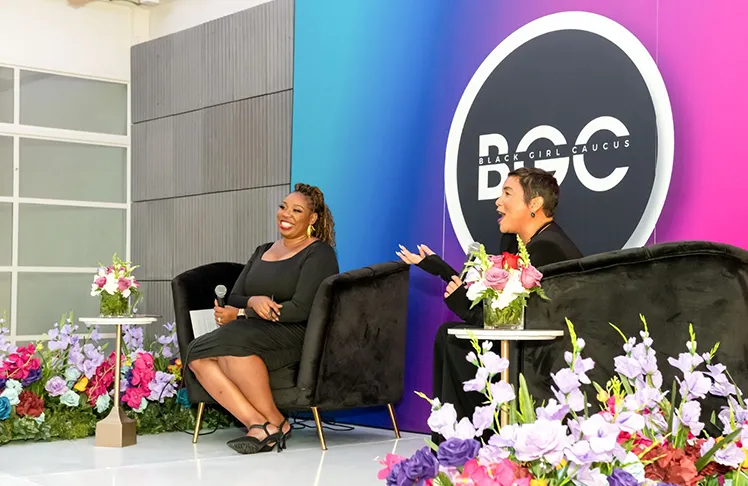
BGC is an unapologetic space where Black women can lead freely, build power collectively and move with joy and clarity. From its leadership lab, “We Lead,” to its “empowerHer Network” and speaker series, BGC offers tools for political influence, career growth and community transformation.
Legette was raised in a union-rooted household in Flint, Michigan. As a child, she marched on picket lines. After graduating from Clark Atlanta University and the University of Georgia School of Law, she taught high school social studies in Atlanta.
She quickly became an advocate for her students, organizing parents and demanding basic resources like textbooks. Her passion for advocacy followed her into law school, where she routinely called out racial disparities and inequities on campus, even when it meant standing alone.
“I didn’t know it was organizing then,” she said. “I just knew I couldn’t stay silent.”
After moving to Houston, Legette co-founded Pure Justice, a local nonprofit focused on grassroots criminal justice reform. She later helped expand the Workers Defense Project in Houston, advocating for workers’ rights and pushing policy reforms. All of that work laid the foundation for what would become BGC.
That vision drew Genesis Draper, the Harris County Chief Public Defender, to the organization. Draper is the first Black woman to hold the role and the first woman, period. BGC represents something long overdue for her. It’s an intentional space for collaboration, restoration and leadership development.
“I honestly couldn’t even conceptualize what the organization was until I stepped into that room,” Draper said. “We’re so used to not centering our needs that it was almost foreign to feel that kind of space, vulnerable, joyful, powerful.”
Draper, a native of Longview, comes from a family of public servants. Her father was a preacher and educator and her mother was an entrepreneur and city employee.
“It was instilled in us early to use your talent to serve others,” she said.
Today, her sisters work in education and social work, continuing the family’s legacy.
But even with decades of experience and purpose, Draper admits the work can feel heavy, especially when Black women are constantly navigating leadership as “firsts.”
“There’s a fatigue that comes with breaking barriers,” she said. “But being in that BGC space reminded me we’re not alone. We’re still in the fight and we’re fighting for each other this time.”
The organization combines policy strategy with emotional restoration, community building and cultural affirmation. Its upcoming “We Choose Us” campaign will gather data from Black women across Houston to define the top issues they want political candidates to address.
“We’re not here to be tokenized or exploited,” Legette said. “We can’t sit around waiting for people to recognize our leadership. We lead. We always have. Now, we’re just doing it out loud.”