
by Denim Fisher
Over the last seven months, the political climate in the United States has become hostile to government programs that celebrate, help, or advance opportunities for Black people. Workplace diversity initiatives have ended, schools banned books about Black history, and budgets for federal anti-poverty programs like Medicaid have been slashed.
Experts say the message to Black America is clear: You’re on your own.
But a new organization, designed to harness the political energy and collective strength of the Black community, is attempting to flip the script. Along with mobilizing urban voters, the State of the People POWER tour aims to help the community connect with resources that help meet everyday needs, like paying utility bills or finding stable housing.
State of the People organizers say their goal is to build a lasting Black power movement that can help heal the community. They also want to help people combat disinformation, build connections, and empower themselves at the ballot box.
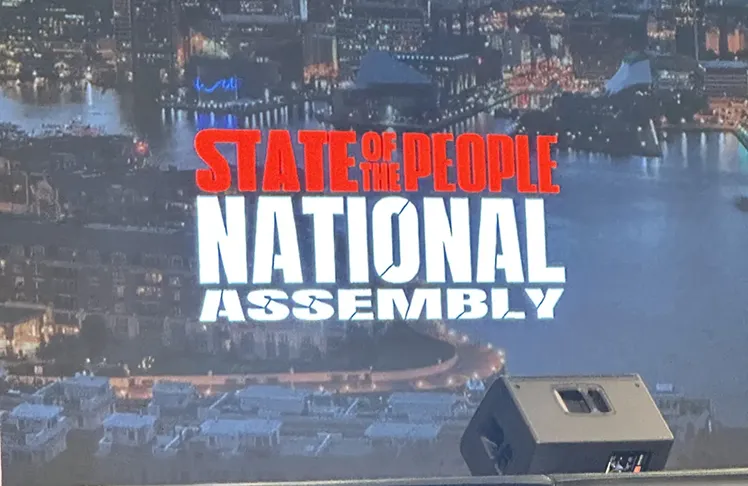
The State of the People POWER Tour kicked off in April in a nationwide 24-hour call to action, streamed online and hosted by activist Angela Rye and comedian Roy Wood Jr. After stopping in 12 cities, including Los Angeles, Detroit, Chicago and other cities with significant Black populations nationwide, the tour reached Baltimore last month for a three-day summit.
Judith Browne Dianis, executive director of the civil rights nonprofit Advancement Project, says the need for organization and advocacy is as urgent as ever — in part to avoid further rollbacks of civil rights in the U.S.
“The freedom that we have in this room and online that I want to recognize is the freedom to gather — the freedom to be together,” Dianis says. “The freedom to be together. We should not take that for granted, because that was unlawful at one period of time.”
A Tough Time for Black America
Designed to create a lasting Black power base, activists say the State of the People POWER tour comes at a fraught political time for Black America. Five years after George Floyd’s murder triggered a racial reckoning, the backlash has been swift and sustained, with legislation curbing civil rights, undoing affirmative action, and shredding the nation’s social safety nets. Meanwhile, middle-class Black families are falling further behind economically, and many working families can’t meet basic household needs.
Attempts to consolidate and harness Black political power, however, is not new.
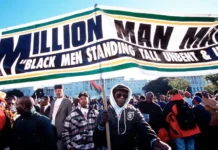
In 1972, activists convened for the National Black Political Convention in Gary, Indiana, with the goal of achieving a shared vision of Black power, healing, and self-determination. And in 1996, Nation of Islam leader Louis Farrakhan organized the Million Man March, a show of unity and shared purpose among Black men on the National Mall in Washington, D.C.
Those movements, however, faded relatively quickly. Rye, who hosts the Native Land podcast, was quoted in Axios as saying she wants to build an organization by and for the people that lasts.
“We keep doing this,” she said. ”But this time, we’re not letting it die on the table.”
Creating Community-Driven Solutions
Youth activist Jalyn Powell says one key is helping Black people understand that they don’t have to accept the country’s backsliding on racial advancement.
“So many people focus on the ways we are going back to being enslaved in various ways, versus seeing the ways we have these underground railroads like Harriet Tubman,” she says. “We’ve been so content and comfortable with the way things are that we’ve stopped seeing an issue.”
The tour’s primary objective is to engage Black communities and address systemic issues through community-driven policy solutions. But a secondary goal is to provide tools for the community to combat misinformation and disinformation — including the release of The State of the People Black Papers, a policy guidebook for local officials.
At the Baltimore event, Marilyn Mosby, the former Baltimore state’s attorney and co-chair of the event, said there is an urgent need for the Black community to come together and “leverage our power across all spectrums to ensure that we have the foundation for what is going to be an imminent crisis within our community.”
Along with workshops and strategy sessions, the summit featured films and a group of African dancers who invited the audience to join in. The significance of witnessing all eight participants get up there and dance was a powerful moment of unity.
One concern that came up during the convening was how would-be activists and organizers should get involved, especially without specific skills. But as Stephanie Keene, a prison abolitionist, once said, “Do what it is you’re good at.”
Rev. Mark A. Thompson, a veteran political activist and a senior adviser at the Institute for Politics, Policy and History, agrees.
“There’s so many aspects to our liberation struggle,” he says. “If everyone in this room picked up one baton in that struggle, in whatever aspect, there’d still be a million more. So there’s enough to go around.”